Advertisements
Advertisements
प्रश्न
What is meant by the statement: "Relative permittivity of water is 81"?
Advertisements
उत्तर
Since water has a relative permittivity of 81, the force between two charges in it will be `1/81` that of the same two charges in a vacuum.
APPEARS IN
संबंधित प्रश्न
- Two insulated charged copper spheres A and B have their centers separated by a distance of 50 cm. What is the mutual force of electrostatic repulsion if the charge on each is 6.5 × 10⁻⁷ C? The radii of A and B are negligible compared to the distance of separation.
- What is the force of repulsion if each sphere is charged double the above amount, and the distance between them is halved?
A particle of mass m and charge (−q) enters the region between the two charged plates initially moving along x-axis with speed vx (like particle 1 in the fig.). The length of plate is L and an uniform electric field E is maintained between the plates. Show that the vertical deflection of the particle at the far edge of the plate is qEL2/(2m`"v"_"x"^2`).
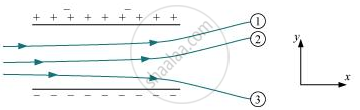
Does the force on a charge due to another charge depend on the charges present nearby?
Four equal charges of 2.0 × 10⁻⁶ C each are fixed at the four corners of a square of side 5 cm. Find the Coulomb's force experienced by one of the charges due to the other three.
Ten positively-charged particles are kept fixed on the x-axis at points x = 10 cm, 20 cm, 30 cm, ...., 100 cm. the first particle has a charge 1.0 × 10⁻⁸ C, the second 8 × 10⁻⁸ C, the third 27 × 10−8 C and so on. The tenth particle has a charge 1000 × 10−8 C. Find the magnitude of the electric force acting on a 1 C charge placed at the origin.
Two identical balls, each with a charge of 2.00 × 10⁻⁷ C and a mass of 100 g, are suspended from a common point by two insulating strings, each 50 cm long. The balls are held at a separation 5.0 cm apart and then released. Find.
(a) the electric force on one of the charged balls
(b) the components of the resultant force on it along and perpendicular to the string
(c) the tension in the string
(d) the acceleration of one of the balls. Answers are to be obtained only for the instant just after the release.
Write a short note on superposition principle.
According to Coulomb's law, which is the correct relation for the following figure?

Two point charges +2 C and +6 C repel each other with a force of 12 N. If a charge of -4 C is given to each of these charges, then the force now is ______.
