Advertisements
Advertisements
प्रश्न
In case of an infinite line charge, how does intensity of electric field at a point change, if at all, when.
- charge on it is doubled?
- distance of the point is halved?
Advertisements
उत्तर
The intensity of the electric field E at a point located at a distance r from the line charge is `E = λ/(2π∈_0r)` where, λ is the charge per unit length.
- The charge on it is doubled.
Given λ = 2λ
∴ E' = `λ/(2π∈_0r)`
New electric field intensity
E' = `(2λ)/(2π∈_0r)`
= `2⋅ λ/(2π∈_0r)`
= 2E
Thus, the intensity of the electric field is doubled. - The distance of the point is halved:
Given, r' = `r/2`
∴ E' = `λ/(2π∈_0r"'")`
New electric field intensity
E' = `λ/(2π∈_0(r/2))`
= `2⋅λ/(2π∈_0r)`
= 2E
Hence, the intensity of the electric field is also doubled in this case.
APPEARS IN
संबंधित प्रश्न
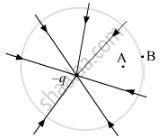
The field lines of a negative point charge are as shown in the figure. Does the kinetic energy of a small negative charge increase or decrease in going from B to A?
Why must electrostatic field at the surface of a charged conductor be normal to the surface at every point? Give reason?
The bob of a simple pendulum has a mass of 40 g and a positive charge of 4.0 × 10⁻⁶ C. It makes 20 oscillations in 45 s. A vertical electric field pointing upward and of magnitude 2.5 × 10⁴ NC−1 is switched on. How much time will it now take to complete 20 oscillations?
The intensity of the electric field at a point at a perpendicular distance ‘r’ from an infinite line charge, having linear charge density ‘λ’ is given by:
A particle of charge q and mass m moves rectilinearly under the action of electric field E = A – Bx, where A and B are positive constants and x is distance from the point where particle was initially at rest then the distance traveled by the particle before coming to rest and acceleration of particle at that moment are respectively.
Let there be a spherically symmetric charge distribution with charge density varying as `rho("r") = rho_0(5/4 - "r"/"R")` upto r = R, and `rho("r") = 0` for r > R, where r is the distance from the origin. The electric field at a distance r(r < R) from the origin is given by _________.
Electric lines of force about negative point charge are ______
A charge of 4 × 10- 9c is distributed uniformly over the circumference of a conducting ring of radius 0.3 m. Calculate the field intensity at a point on the axis of the ring at 0.4 m from its center and also at the center?
Two equal point charges of the same sign are fixed on the y-axis, on either side of the origin equidistant from it, with the distance between them d. A third charge moves along the x-axis. The distance of the third charge from either of the two fixed charges when force on the third charge is maximum will be ______ cm.
[d = 10 cm]
