Advertisements
Advertisements
प्रश्न
Two charges 2.0 × 10⁻⁶ C and 1.0 × 10⁻⁶ C are placed at a separation of 10 cm. Where should a third charge be placed, such that it experiences no net force due to these charges?
Advertisements
उत्तर
Given:
\[q_1 = 2 . 0 \times {10}^{- 6} C\]
\[ q_2 = 1 . 0 \times {10}^{- 6} C\]
Let the third charge, q, be placed at a distance of x cm from charge q1, as shown in the figure.
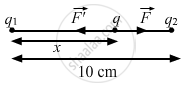
\[ \Rightarrow \frac{9 \times {10}^9 \times 2 \times {10}^{- 6} \times q}{x^2} = \frac{9 \times {10}^9 \times {10}^{- 6} \times q}{\left( 10 - x \right)^2}\]
\[ \Rightarrow x^2 = 2 \left( 10 - x \right)^2 \]
\[ \Rightarrow x^2 - 40x + 200 = 0\]
\[ \Rightarrow x = 20 \pm 10\sqrt{2}\]
\[ \Rightarrow x = 5 . 9 \text{ cm } ( \because x \neq 20 + 10\sqrt{2})\]
So, the third charge should be placed at a distance of 5.9 cm from q1.
APPEARS IN
संबंधित प्रश्न
Two equal balls with equal positive charge 'q' coulombs are suspended by two insulating strings of equal length. What would be the effect on the force when a plastic sheet is inserted between the two?
A charge of 1.0 C is placed at the top of your college building and another equal charge at the top of your house. Take the separation between the two charges to be 2.0 km. Find the force exerted by the charges on each other. How many times your weight is this force?
At what separation should two equal charges, 1.0 C each, be placed, so that the force between them equals the weight of a 50 kg person?
One end of a 10 cm long silk thread is fixed to a large vertical surface of a charged non-conducting plate and the other end is fastened to a small ball of mass 10 g and a charge of 4.0× 10⁻⁶ C. In equilibrium, the thread makes an angle of 60° with the vertical. Find the surface charge density on the plate.
A particle with a charge of 2.0 × 10⁻⁴ C is placed directly below and at a separation of 10 cm from the bob of a simple pendulum at rest. The mass of the bob is 100 g. What charge should the bob be given so that the string becomes loose?
Two identically-charged particles are fastened to the two ends of a spring of spring constant 100 N m−1 and natural length 10 cm. The system rests on a smooth horizontal table. If the charge on each particle is 2.0 × 10⁻⁸ C, find the extension in the length of the spring. Assume that the extension is small as compared to the natural length. Justify this assumption after you solve the problem.
A particle A with a charge of 2.0 × 10⁻⁶ C is held fixed on a horizontal table. A second charged particle of mass 80 g stays in equilibrium on the table at a distance of 10 cm from the first charge. The coefficient of friction between the table and this second particle is μ = 0.2. Find the range within which the charge of this second particle may lie.
A particle A with a charge of 2.0 × 10⁻⁶ C and a mass of 100 g is placed at the bottom of a smooth inclined plane of inclination 30°. Where should another particle B, with the same charge and mass, be placed on the incline so that it may remain in equilibrium?
Two particles A and B possessing charges of +2.00 × 10⁻⁶ C and of −4.00 × 10⁻⁶ C, respectively, are held fixed at a separation of 20.0 cm. Locate the points (s) on the line AB, where (a) the electric field is zero (b) the electric potential is zero.
Write down Coulomb’s law in vector form and mention what each term represents.
What are the differences between the Coulomb force and the gravitational force?
Explain in detail Coulomb’s law and its various aspects.
The force between two charges 0.06 m apart is 5 N. If each charge is moved towards the other by 0.01 m, then the force between them will become ______.
Two positive charges ______.
Two identical thin rings, each of radius a meter, are coaxially placed at a distance R meter apart. If Q1 coulomb and Q2 coulomb are respectively the charges uniformly spread on the two rings, the work done in moving a charge q coulomb from the centre of one ring to that of the other is ______.
Two point charges +2 C and +6 C repel each other with a force of 12 N. If a charge of -4 C is given to each of these charges, then the force now is ______.
