Advertisements
Advertisements
प्रश्न
Two charges 2.0 × 10⁻⁶ C and 1.0 × 10⁻⁶ C are placed at a separation of 10 cm. Where should a third charge be placed, such that it experiences no net force due to these charges?
Advertisements
उत्तर
Given:
\[q_1 = 2 . 0 \times {10}^{- 6} C\]
\[ q_2 = 1 . 0 \times {10}^{- 6} C\]
Let the third charge, q, be placed at a distance of x cm from charge q1, as shown in the figure.
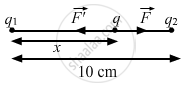
\[ \Rightarrow \frac{9 \times {10}^9 \times 2 \times {10}^{- 6} \times q}{x^2} = \frac{9 \times {10}^9 \times {10}^{- 6} \times q}{\left( 10 - x \right)^2}\]
\[ \Rightarrow x^2 = 2 \left( 10 - x \right)^2 \]
\[ \Rightarrow x^2 - 40x + 200 = 0\]
\[ \Rightarrow x = 20 \pm 10\sqrt{2}\]
\[ \Rightarrow x = 5 . 9 \text{ cm } ( \because x \neq 20 + 10\sqrt{2})\]
So, the third charge should be placed at a distance of 5.9 cm from q1.
APPEARS IN
संबंधित प्रश्न
Find the dimensional formula of ε0.
One end of a 10 cm long silk thread is fixed to a large vertical surface of a charged non-conducting plate and the other end is fastened to a small ball of mass 10 g and a charge of 4.0× 10⁻⁶ C. In equilibrium, the thread makes an angle of 60° with the vertical. Find the surface charge density on the plate.
A hydrogen atom contains one proton and one electron. It may be assumed that the electron revolves in a circle of radius 0.53 angstrom (1 angstrom = 10−10 m and is abbreviated as Å ) with the proton at the centre. The hydrogen atom is said to be in the ground state in this case. Find the magnitude of the electric force between the proton and the electron of a hydrogen atom in its ground state.
Two particles A and B, each carrying a charge Q, are held fixed with a separation dbetween them. A particle C of mass m and charge q is kept at the middle point of the line AB. Assuming x<<d, show that this force is proportional to x.
Two particles A and B, each carrying a charge Q, are held fixed with a separation dbetween them. A particle C of mass m and charge q is kept at the middle point of the line AB. Under what conditions will the particle C execute simple harmonic motion if it is released after such a small displacement? Find the time period of the oscillations if these conditions are satisfied.
A point charge produces an electric field of magnitude 5.0 NC−1 at a distance of 40 cm from it. What is the magnitude of the charge?
A water particle of mass 10.0 mg and with a charge of 1.50 × 10⁻⁶ C stays suspended in a room. What is the magnitude of electric field in the room? What is its direction ?
What are the differences between the Coulomb force and the gravitational force?
Three charges +Q, q, +Q are placed respectively, at distance, 0, d/2 and d from the origin, on the X-axis. If the net force experienced by +Q, placed at x = 0, is zero then value of q is ____________.
A total charge Q is broken in two parts Q1 and Q2 and they are placed at a distance R from each other. The maximum force of repulsion between them will occur, when ____________.
Polarised dielectric is equivalent to ______.
Two point charges +3 µC and +8 µC repel each other with a force of 40 N. If a charge of -5 µC is added to each of them, then force between them will become ______.
Two positive charges ______.
The unit of charge is ______.
The S.I unit of electric permittivity is
Identify the wrong statement in the following.
Coulomb's law correctly describes the electric force that ______.
Electric charge of any system is ______.
Two charges q and – 3q are placed fixed on x-axis separated by distance ‘d’. Where should a third charge 2q be placed such that it will not experience any force?
The ratio of the forces between two charges placed at a certain distance apart in the air and by the same distance apart in a medium of dielectric constant K is ______.
