Advertisements
Advertisements
Question
Two charges 2.0 × 10⁻⁶ C and 1.0 × 10⁻⁶ C are placed at a separation of 10 cm. Where should a third charge be placed, such that it experiences no net force due to these charges?
Advertisements
Solution
Given:
\[q_1 = 2 . 0 \times {10}^{- 6} C\]
\[ q_2 = 1 . 0 \times {10}^{- 6} C\]
Let the third charge, q, be placed at a distance of x cm from charge q1, as shown in the figure.
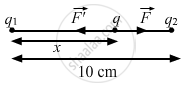
\[ \Rightarrow \frac{9 \times {10}^9 \times 2 \times {10}^{- 6} \times q}{x^2} = \frac{9 \times {10}^9 \times {10}^{- 6} \times q}{\left( 10 - x \right)^2}\]
\[ \Rightarrow x^2 = 2 \left( 10 - x \right)^2 \]
\[ \Rightarrow x^2 - 40x + 200 = 0\]
\[ \Rightarrow x = 20 \pm 10\sqrt{2}\]
\[ \Rightarrow x = 5 . 9 \text{ cm } ( \because x \neq 20 + 10\sqrt{2})\]
So, the third charge should be placed at a distance of 5.9 cm from q1.
APPEARS IN
RELATED QUESTIONS
- Two insulated charged copper spheres A and B have their centers separated by a distance of 50 cm. What is the mutual force of electrostatic repulsion if the charge on each is 6.5 × 10⁻⁷ C? The radii of A and B are negligible compared to the distance of separation.
- What is the force of repulsion if each sphere is charged double the above amount, and the distance between them is halved?
Four charges +q, −q, +q and −q are to be arranged respectively at the four corners of a square ABCD of side 'a'.
(a) Find the work required to put together this arrangement.
(b) A charge q0 is brought to the centre of the square, the four charges being held fixed. How much extra work is needed to do this ?
At what separation should two equal charges, 1.0 C each, be placed, so that the force between them equals the weight of a 50 kg person?
Two charged particles are placed 1.0 cm apart. What is the minimum possible magnitude of the electric force acting on each charge?
Estimate the number of electrons in 100 g of water. How much is the total negative charge on these electrons?
Three equal charges, 2.0 × 10⁻⁶ C each, are held at the three corners of an equilateral triangle of side 5 cm. Find the Coulomb force experienced by one of the charges due to the other two.
Two small spheres, each with a mass of 20 g, are suspended from a common point by two insulating strings of length 40 cm each. The spheres are identically charged and the separation between the balls at equilibrium is found to be 4 cm. Find the charge on each sphere.
A particle with a charge of 2.0 × 10⁻⁴ C is placed directly below and at a separation of 10 cm from the bob of a simple pendulum at rest. The mass of the bob is 100 g. What charge should the bob be given so that the string becomes loose?
A particle A with a charge of 2.0 × 10⁻⁶ C and a mass of 100 g is placed at the bottom of a smooth inclined plane of inclination 30°. Where should another particle B, with the same charge and mass, be placed on the incline so that it may remain in equilibrium?
Solve numerical example.
Three equal charges of 10×10-8 C respectively, each located at the corners of a right triangle whose sides are 15 cm, 20 cm, and 25cm respectively. Find the force exerted on the charge located at the 90° angle.
What are the differences between the Coulomb force and the gravitational force?
A spring of spring constant 5 × 10³ N/m is stretched initially by 5 cm from the unstretched position. Then the work required to stretch it further by another 5 cm is:
Coulomb's law is given by F = k q1q2 rn where n is
Two charge – 10c and + 10 c are placed 10 cm apart. Potential at centre of the line joining the two charge is:-
The S.I unit of electric permittivity is
Identify the wrong statement in the following.
Coulomb's law correctly describes the electric force that ______.
According to Coulomb's law, which is the correct relation for the following figure?

Two point charges Q each are placed at a distance d apart. A third point charge q is placed at a distance x from the mid-point on the perpendicular bisector. The value of x at which charge q will experience the maximum Coulomb's force is ______.
What is meant by the statement: "Relative permittivity of water is 81"?
