Advertisements
Advertisements
प्रश्न
Suppose the second charge in the previous problem is −1.0 × 10⁻⁶ C. Locate the position where a third charge will not experience a net force.
Advertisements
उत्तर
Given:
\[q_1 = 2 \times {10}^{- 6} C\]
\[ q_2 = - 1 \times {10}^{- 6} C\]
Since both the charges are opposite in nature, the third charge cannot be placed between them. Let the third charge, q, be placed at a distance of x cm from charge q1, as shown in the figure.
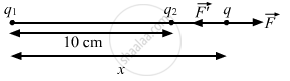
By Coulomb's Law, force,
\[F - F' = 0\]
\[\Rightarrow F = F'\]
\[ \Rightarrow \frac{9 \times {10}^9 \times 2 \times {10}^{- 6} \times q}{x^2} = \frac{9 \times {10}^9 \times {10}^{- 6} \times q}{\left( x - 10 \right)^2}\]
\[ \Rightarrow x^2 = 2 \left( x - 10 \right)^2 \]
\[ \Rightarrow x^2 - 40x + 200 = 0\]
\[ \Rightarrow x = 20 \pm 10\sqrt{2} \text{ m} \]
\[ \Rightarrow x = 34 . 14 \text{ cm } ( \because x \neq 20 - 10\sqrt{2})\]
APPEARS IN
संबंधित प्रश्न
Four point charges qA = 2 μC, qB = −5 μC, qC = 2 μC, and qD = −5 μC are located at the corners of a square ABCD of side 10 cm. What is the force on a charge of 1 μC placed at the centre of the square?
Three-point charges q, – 4q and 2q are placed at the vertices of an equilateral triangle ABC of side 'l' as shown in the figure. Obtain the expression for the magnitude of the resultant electric force acting on the charge q

(b) Find out the amount of the work done to separate the charges at infinite distance.
Four charges +q, −q, +q and −q are to be arranged respectively at the four corners of a square ABCD of side 'a'.
(a) Find the work required to put together this arrangement.
(b) A charge q0 is brought to the centre of the square, the four charges being held fixed. How much extra work is needed to do this ?
Find the electric force between two protons separated by a distance of 1 fermi (1 fermi = 10−15 m). The protons in a nucleus remain at a separation of this order.
Two charges 2.0 × 10⁻⁶ C and 1.0 × 10⁻⁶ C are placed at a separation of 10 cm. Where should a third charge be placed, such that it experiences no net force due to these charges?
Two identical pith balls are charged by rubbing one against the other. They are suspended from a horizontal rod through two strings of length 20 cm each, the separation between the suspension points being 5 cm. In equilibrium, the separation between the balls is 3 cm. Find the mass of each ball and the tension in the strings. The charge on each ball has a magnitude 2.0 × 10⁻⁸ C.
Two small spheres, each with a mass of 20 g, are suspended from a common point by two insulating strings of length 40 cm each. The spheres are identically charged and the separation between the balls at equilibrium is found to be 4 cm. Find the charge on each sphere.
A particle A with a charge of 2.0 × 10⁻⁶ C and a mass of 100 g is placed at the bottom of a smooth inclined plane of inclination 30°. Where should another particle B, with the same charge and mass, be placed on the incline so that it may remain in equilibrium?
Repeat the previous problem if the particle C is displaced through a distance x along the line AB.
Two particles A and B possessing charges of +2.00 × 10⁻⁶ C and of −4.00 × 10⁻⁶ C, respectively, are held fixed at a separation of 20.0 cm. Locate the points (s) on the line AB, where (a) the electric field is zero (b) the electric potential is zero.
A point charge produces an electric field of magnitude 5.0 NC−1 at a distance of 40 cm from it. What is the magnitude of the charge?
Two equal charges, 2.0 × 10⁻⁷ C each, are held fixed at a separation of 20 cm. A third charge of equal magnitude is placed midway between the two charges. It is now moved to a point 20 cm from both the charges. How much work is done by the electric field during the process?
Two identical particles, each with a charge of 2.0 × 10⁻⁴ C and mass of 10 g, are kept at a separation of 10 cm and then released. What would be the speed of the particles when the separation becomes large?
What is relative permittivity?
What are the differences between the Coulomb force and the gravitational force?
Two-point charges of + 0.2 µµC and -0.2 µµC are separated by 1 o8 m. What is the value of the electric field at an axial point at a distance of 0.1 m from their mid-point?
The force between two charges 0.06 m apart is 5 N. If each charge is moved towards the other by 0.01 m, then the force between them will become ______.
Two charges q and – 3q are placed fixed on x-axis separated by distance ‘d’. Where should a third charge 2q be placed such that it will not experience any force?
