Advertisements
Advertisements
प्रश्न
Suppose the second charge in the previous problem is −1.0 × 10⁻⁶ C. Locate the position where a third charge will not experience a net force.
Advertisements
उत्तर
Given:
\[q_1 = 2 \times {10}^{- 6} C\]
\[ q_2 = - 1 \times {10}^{- 6} C\]
Since both the charges are opposite in nature, the third charge cannot be placed between them. Let the third charge, q, be placed at a distance of x cm from charge q1, as shown in the figure.
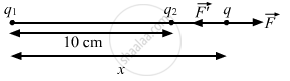
By Coulomb's Law, force,
\[F - F' = 0\]
\[\Rightarrow F = F'\]
\[ \Rightarrow \frac{9 \times {10}^9 \times 2 \times {10}^{- 6} \times q}{x^2} = \frac{9 \times {10}^9 \times {10}^{- 6} \times q}{\left( x - 10 \right)^2}\]
\[ \Rightarrow x^2 = 2 \left( x - 10 \right)^2 \]
\[ \Rightarrow x^2 - 40x + 200 = 0\]
\[ \Rightarrow x = 20 \pm 10\sqrt{2} \text{ m} \]
\[ \Rightarrow x = 34 . 14 \text{ cm } ( \because x \neq 20 - 10\sqrt{2})\]
APPEARS IN
संबंधित प्रश्न
A particle of mass m and charge (−q) enters the region between the two charged plates initially moving along x-axis with speed vx (like particle 1 in the fig.). The length of plate is L and an uniform electric field E is maintained between the plates. Show that the vertical deflection of the particle at the far edge of the plate is qEL2/(2m`"v"_"x"^2`).

Write any two important points of similarities and differences each between Coulomb's law for the electrostatic field and Biot-Savart's law of the magnetic field ?
Two charged particles are placed 1.0 cm apart. What is the minimum possible magnitude of the electric force acting on each charge?
Four equal charges of 2.0 × 10⁻⁶ C each are fixed at the four corners of a square of side 5 cm. Find the Coulomb's force experienced by one of the charges due to the other three.
Find the speed of the electron in the ground state of a hydrogen atom. The description of ground state is given in the previous problem.
Two identically-charged particles are fastened to the two ends of a spring of spring constant 100 N m−1 and natural length 10 cm. The system rests on a smooth horizontal table. If the charge on each particle is 2.0 × 10⁻⁸ C, find the extension in the length of the spring. Assume that the extension is small as compared to the natural length. Justify this assumption after you solve the problem.
Two particles A and B, each carrying a charge Q, are held fixed with a separation dbetween them. A particle C of mass m and charge q is kept at the middle point of the line AB. Assuming x<<d, show that this force is proportional to x.
Two particles A and B possessing charges of +2.00 × 10⁻⁶ C and of −4.00 × 10⁻⁶ C, respectively, are held fixed at a separation of 20.0 cm. Locate the points (s) on the line AB, where (a) the electric field is zero (b) the electric potential is zero.
A water particle of mass 10.0 mg and with a charge of 1.50 × 10⁻⁶ C stays suspended in a room. What is the magnitude of electric field in the room? What is its direction ?
Two particles of masses 5.0 g each and opposite charges of +4.0 × 10⁻⁵ C and −4.0 × 10⁻⁵ C are released from rest with a separation of 1.0 m between them. Find the speeds of the particles when the separation is reduced to 50 cm.
What is relative permittivity?
A force F acts between sodium and chlorine ions of salt (sodium chloride) when put 1 cm apart in air. The permittivity of air and dielectric constant of water are `epsilon_0` and K respectively. When a piece of salt is put in water, electrical force acting between sodium and chlorine ions 1 cm apart is ____________.
The force between two charges 0.06 m apart is 5 N. If each charge is moved towards the other by 0.01 m, then the force between them will become ______.
The electric force acting between two point charges kept at a certain distance in vacuum is 16 N. If the same two charges are kept at the same distance in a medium of dielectric constant 8, the electric force acting between them is ____________ N.
Two positive charges ______.
A spring of spring constant 5 × 10³ N/m is stretched initially by 5 cm from the unstretched position. Then the work required to stretch it further by another 5 cm is:
