हिंदी
कर्नाटक बोर्ड पी.यू.सी.पीयूसी विज्ञान कक्षा ११

Two Equal Charges, 2.0 × 10⁻⁷ C Each, Are Held Fixed at a Separation of 20 Cm. a Third Charge of Equal Magnitude is Placed Midway Between the Two Charges. - Physics

Advertisements
Advertisements

प्रश्न

Two equal charges, 2.0 × 10⁻⁷ C each, are held fixed at a separation of 20 cm. A third charge of equal magnitude is placed midway between the two charges. It is now moved to a point 20 cm from both the charges. How much work is done by the electric field during the process?

संख्यात्मक
Advertisements

उत्तर

Let the third charge be moved from point A to point B.  
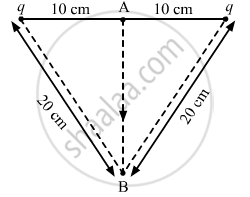
Magnitude of the charges, q = 2.0 × 10⁻⁷ C
Distance of both the charges from point A, r = 10 cm =0.1 m
Distance of both the charges from point B, r' = 20 cm =0.2 m
Potential at A,

\[V_A  = 2 \times \frac{1}{4\pi \epsilon_0}\frac{q}{r}\]

Potential at B,

\[V_B  = 2 \times \frac{1}{4\pi \epsilon_0}\frac{q}{r'}\]

Work done, 

\[W = q\left( V_B - V_A \right)\]

\[\Rightarrow W = 2 \times  {10}^{- 7} \left[ \frac{2 \times 2 \times {10}^{- 7}}{4 \pi\epsilon_0}\left( \frac{1}{0 . 1} - \frac{1}{0 . 2} \right) \right]\] 

\[ \Rightarrow W = 3 . 6 \times  {10}^{- 3}\]   J

 
shaalaa.com
  क्या इस प्रश्न या उत्तर में कोई त्रुटि है?
अध्याय 7: Electric Field and Potential - Exercises [पृष्ठ १२३]

APPEARS IN

एचसी वर्मा Concepts of Physics Vol. 2 [English] Class 11 and 12
अध्याय 7 Electric Field and Potential
Exercises | Q 55 | पृष्ठ १२३

संबंधित प्रश्न

Suppose that the particle is an electron projected with velocity vx = 2.0 × 10⁶ m s−1. If E between the plates separated by 0.5 cm is 9.1 × 10² N/C, where will the electron strike the upper plate? (|e| = 1.6 × 10⁻¹⁹ C, m= 9.1 × 10⁻³¹ kg)


At what separation should two equal charges, 1.0 C each, be placed, so that the force between them equals the weight of a 50 kg person? 


Two equal charges are placed at a separation of 1.0 m. What should be the magnitude of the charges, so that the force between them equals the weight of a 50 kg person?


One end of a 10 cm long silk thread is fixed to a large vertical surface of a charged non-conducting plate and the other end is fastened to a small ball of mass 10 g and a charge of 4.0× 10⁻⁶ C. In equilibrium, the thread makes an angle of 60° with the vertical. Find the surface charge density on the plate.


Find the ratio of the electrical and gravitational forces between two protons.


Suppose an attractive nuclear force acts between two protons which may be written as F=Ce−kr/r2. Write down the dimensional formulae and appropriate SI units of C and k.   


Three equal charges, 2.0 × 106 C each, are held at the three corners of an equilateral triangle of side 5 cm. Find the Coulomb force experienced by one of the charges due to the other two.  


Find the speed of the electron in the ground state of a hydrogen atom. The description of ground state is given in the previous problem.


Ten positively-charged particles are kept fixed on the x-axis at points x = 10 cm, 20 cm, 30 cm, ...., 100 cm. the first particle has a charge 1.0 × 10⁻⁸ C, the second 8 × 10⁻⁸ C, the third 27 × 10−8 C and so on. The tenth particle has a charge 1000 × 10−8 C.  Find the magnitude of the electric force acting on a 1 C charge placed at the origin. 


Two identical pith balls are charged by rubbing one against the other. They are suspended from a horizontal rod through two strings of length 20 cm each, the separation between the suspension points being 5 cm. In equilibrium, the separation between the balls is 3 cm. Find the mass of each ball and the tension in the strings. The charge on each ball has a magnitude 2.0 × 10⁻⁸ C.


Two small spheres, each with a mass of 20 g, are suspended from a common point by two insulating strings of length 40 cm each. The spheres are identically charged and the separation between the balls at equilibrium is found to be 4 cm. Find the charge on each sphere. 


Two identical pith balls, each carrying a charge q, are suspended from a common point by two strings of equal length l. Find the mass of each ball if the angle between the strings is 2θ in equilibrium. 


Two particles A and B, each carrying a charge Q, are held fixed with a separation dbetween them. A particle C of mass m and charge q is kept at the middle point of the line AB. If it is displaced through a distance x perpendicular to AB, what would be the electric force experienced by it?  


Two particles A and B possessing charges of +2.00 × 10⁻⁶ C and of −4.00 × 10⁻⁶ C, respectively, are held fixed at a separation of 20.0 cm. Locate the points (s) on the line AB, where (a) the electric field is zero (b) the electric potential is zero.  


A point charge produces an  electric field of magnitude 5.0 NC−1 at a distance of 40 cm from it. What is the magnitude of the charge?


Three identical charges, each with a value of 1.0 × 10⁻⁸ C, are placed at the corners of an equilateral triangle of side 20 cm. Find the electric field and potential at the centre of the triangle. 


The law, governing the force between electric charges is known as ______.

A charge Q is divided into two parts of q and Q – q. If the coulomb repulsion between them when they are separated is to be maximum, the ratio of Q/q should be ______.


Four equal charges q are placed at the four comers A, B, C, D of a square of length a. The magnitude of the force on the charge at B will be ______.


Two charges of equal magnitudes kept at a distance r exert a force F on each other. If the charges are halved and distance between them is doubled, then the new force acting on each charge is ______.


Share
Notifications

Englishहिंदीमराठी


      Forgot password?
Use app×