Advertisements
Advertisements
Question
Two equal charges, 2.0 × 10⁻⁷ C each, are held fixed at a separation of 20 cm. A third charge of equal magnitude is placed midway between the two charges. It is now moved to a point 20 cm from both the charges. How much work is done by the electric field during the process?
Advertisements
Solution
Let the third charge be moved from point A to point B.
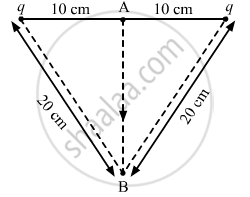
Magnitude of the charges, q = 2.0 × 10⁻⁷ C
Distance of both the charges from point A, r = 10 cm =0.1 m
Distance of both the charges from point B, r' = 20 cm =0.2 m
Potential at A,
\[V_A = 2 \times \frac{1}{4\pi \epsilon_0}\frac{q}{r}\]
Potential at B,
\[V_B = 2 \times \frac{1}{4\pi \epsilon_0}\frac{q}{r'}\]
Work done,
\[\Rightarrow W = 2 \times {10}^{- 7} \left[ \frac{2 \times 2 \times {10}^{- 7}}{4 \pi\epsilon_0}\left( \frac{1}{0 . 1} - \frac{1}{0 . 2} \right) \right]\]
\[ \Rightarrow W = 3 . 6 \times {10}^{- 3}\] J
