मराठी
कर्नाटक बोर्ड पी.यू.सी.पीयूसी विज्ञान इयत्ता ११

Two Equal Charges, 2.0 × 10⁻⁷ C Each, Are Held Fixed at a Separation of 20 Cm. a Third Charge of Equal Magnitude is Placed Midway Between the Two Charges. - Physics

Advertisements
Advertisements

प्रश्न

Two equal charges, 2.0 × 10⁻⁷ C each, are held fixed at a separation of 20 cm. A third charge of equal magnitude is placed midway between the two charges. It is now moved to a point 20 cm from both the charges. How much work is done by the electric field during the process?

संख्यात्मक
Advertisements

उत्तर

Let the third charge be moved from point A to point B.  
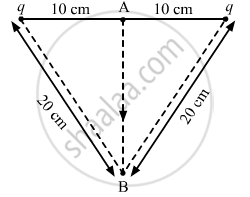
Magnitude of the charges, q = 2.0 × 10⁻⁷ C
Distance of both the charges from point A, r = 10 cm =0.1 m
Distance of both the charges from point B, r' = 20 cm =0.2 m
Potential at A,

\[V_A  = 2 \times \frac{1}{4\pi \epsilon_0}\frac{q}{r}\]

Potential at B,

\[V_B  = 2 \times \frac{1}{4\pi \epsilon_0}\frac{q}{r'}\]

Work done, 

\[W = q\left( V_B - V_A \right)\]

\[\Rightarrow W = 2 \times  {10}^{- 7} \left[ \frac{2 \times 2 \times {10}^{- 7}}{4 \pi\epsilon_0}\left( \frac{1}{0 . 1} - \frac{1}{0 . 2} \right) \right]\] 

\[ \Rightarrow W = 3 . 6 \times  {10}^{- 3}\]   J

 
shaalaa.com
  या प्रश्नात किंवा उत्तरात काही त्रुटी आहे का?
पाठ 7: Electric Field and Potential - Exercises [पृष्ठ १२३]

APPEARS IN

एचसी वर्मा Concepts of Physics Vol. 2 [English] Class 11 and 12
पाठ 7 Electric Field and Potential
Exercises | Q 55 | पृष्ठ १२३

संबंधित प्रश्‍न

Four charges +q, −q, +q and −q are to be arranged respectively at the four corners of a square ABCD of side 'a'.
(a) Find the work required to put together this arrangement.
(b) A charge q0 is brought to the centre of the square, the four charges being held fixed. How much extra work is needed to do this ?


Find the dimensional formula of ε0.


A charge of 1.0 C is placed at the top of your college building and another equal charge at the top of your house. Take the separation between the two charges to be 2.0 km. Find the force exerted by the charges on each other. How many times your weight is this force?


Suppose all the electrons of 100 g water are lumped together to form a negatively-charged particle and all the nuclei are lumped together to form a positively-charged particle. If these two particles are placed 10.0 cm away from each other, find the force of attraction between them. Compare it with your weight.


Consider a gold nucleus to be a sphere of radius 6.9 fermi in which protons and neutrons are distributed. Find the force of repulsion between two protons situated at largest separation. Why do these protons not fly apart under this repulsion?


Suppose an attractive nuclear force acts between two protons which may be written as F=Ce−kr/r2. Write down the dimensional formulae and appropriate SI units of C and k.   


Three equal charges, 2.0 × 106 C each, are held at the three corners of an equilateral triangle of side 5 cm. Find the Coulomb force experienced by one of the charges due to the other two.  


Four equal charges of 2.0 × 10⁻⁶ C each are fixed at the four corners of a square of side 5 cm. Find the Coulomb's force experienced by one of the charges due to the other three. 


Two charged particles with charge 2.0 × 10⁻⁸ C each are joined by an insulating string of length 1 m and the system is kept on a smooth horizontal table. Find the tension in the string.


Two identical pith balls are charged by rubbing one against the other. They are suspended from a horizontal rod through two strings of length 20 cm each, the separation between the suspension points being 5 cm. In equilibrium, the separation between the balls is 3 cm. Find the mass of each ball and the tension in the strings. The charge on each ball has a magnitude 2.0 × 10⁻⁸ C.


A particle A with a charge of 2.0 × 10⁻⁶ C is held fixed on a horizontal table. A second charged particle of mass 80 g stays in equilibrium on the table at a distance of 10 cm from the first charge. The coefficient of friction between the table and this second particle is μ = 0.2. Find the range within which the charge of this second particle may lie.


Repeat the previous problem if the particle C is displaced through a distance x along the line AB. 


How much work has to be done in assembling three charged particles at the vertices of an equilateral triangle, as shown in the figure?


Two particles of masses 5.0 g each and opposite charges of +4.0 × 10⁻⁵ C and −4.0 × 10⁻⁵ C are released from rest with a separation of 1.0 m between them. Find the speeds of the particles when the separation is reduced to 50 cm.  


Write down Coulomb’s law in vector form and mention what each term represents.


Coulomb’s law is true for ______.

Two identical thin rings, each of radius a meter, are coaxially placed at a distance R meter apart. If Q1 coulomb and Q2 coulomb are respectively the charges uniformly spread on the two rings, the work done in moving a charge q coulomb from the centre of one ring to that of the other is ______.


Four equal charges q are placed at the four comers A, B, C, D of a square of length a. The magnitude of the force on the charge at B will be ______.


The capacity of an isolate conducting sphere of radius R is proportional to


Share
Notifications

Englishहिंदीमराठी


      Forgot password?
Use app×