हिंदी
कर्नाटक बोर्ड पी.यू.सी.पीयूसी विज्ञान कक्षा ११

Two Particles A And B, Each Carrying a Charge Q, Are Held Fixed with a Separation Dbetween Them. If It is Displaced Through a Distance X Perpendicular To Ab, What Would Be the Electric Force - Physics

Advertisements
Advertisements

प्रश्न

Two particles A and B, each carrying a charge Q, are held fixed with a separation dbetween them. A particle C of mass m and charge q is kept at the middle point of the line AB. If it is displaced through a distance x perpendicular to AB, what would be the electric force experienced by it?  

टिप्पणी लिखिए
Advertisements

उत्तर

 The charge q is displaced by a distance x on the perpendicular bisector of AB.
As shown in the figure, the horizontal component of the force is balanced.  
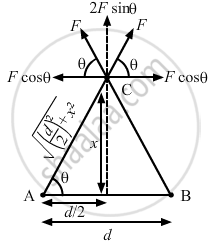
\[\sin\theta = \frac{x}{\sqrt{\left( \frac{d}{2} \right)^2 + x^2}}\]

Total vertical component of the force,

\[F' = 2F\sin\theta\]

\[F' = 2 \times \frac{1}{4\pi \epsilon_0} \times \frac{qQ}{\left( \frac{d}{2} \right)^2 + x^2} \times \frac{x}{\sqrt{\left( \frac{d}{2} \right)^2 + x^2}}\] 

\[ \Rightarrow F' = \frac{1}{2\pi \epsilon_0} \times \frac{qQx}{\left[ \left( \frac{d}{2} \right)^2 + x^2 \right]^{3/2}}\]

This is the net electric force experienced by the charge q.

shaalaa.com
  क्या इस प्रश्न या उत्तर में कोई त्रुटि है?
अध्याय 7: Electric Field and Potential - Exercises [पृष्ठ १२२]

APPEARS IN

एचसी वर्मा Concepts of Physics Vol. 2 [English] Class 11 and 12
अध्याय 7 Electric Field and Potential
Exercises | Q 32.1 | पृष्ठ १२२

संबंधित प्रश्न

Two equal balls with equal positive charge 'q' coulombs are suspended by two insulating strings of equal length. What would be the effect on the force when a plastic sheet is inserted between the two?


The electrostatic force on a small sphere of charge 0.4 μC due to another small sphere of charge − 0.8 μC in air is 0.2 N.

  1. What is the distance between the two spheres?
  2. What is the force on the second sphere due to the first?

A particle of mass m and charge (−q) enters the region between the two charged plates initially moving along x-axis with speed vx (like particle 1 in the fig.). The length of plate is L and an uniform electric field E is maintained between the plates. Show that the vertical deflection of the particle at the far edge of the plate is qEL2/(2m`"v"_"x"^2`).


Does the force on a charge due to another charge depend on the charges present nearby?


One end of a 10 cm long silk thread is fixed to a large vertical surface of a charged non-conducting plate and the other end is fastened to a small ball of mass 10 g and a charge of 4.0× 10⁻⁶ C. In equilibrium, the thread makes an angle of 60° with the vertical. Find the surface charge density on the plate.


Suppose the second charge in the previous problem is −1.0 × 10⁶ C. Locate the position where a third charge will not experience a net force. 


Two charged particles are placed 1.0 cm apart. What is the minimum possible magnitude of the electric force acting on each charge?


Four equal charges of 2.0 × 10⁻⁶ C each are fixed at the four corners of a square of side 5 cm. Find the Coulomb's force experienced by one of the charges due to the other three. 


A particle A with a charge of 2.0 × 10⁻⁶ C is held fixed on a horizontal table. A second charged particle of mass 80 g stays in equilibrium on the table at a distance of 10 cm from the first charge. The coefficient of friction between the table and this second particle is μ = 0.2. Find the range within which the charge of this second particle may lie.


Two identical particles, each with a charge of 2.0 × 10⁻⁴ C and mass of 10 g, are kept at a separation of 10 cm and then released. What would be the speed of the particles when the separation becomes large?


Define a unit charge.


Explain in detail Coulomb’s law and its various aspects.


The law, governing the force between electric charges is known as ______.

Two identical thin rings, each of radius a meter, are coaxially placed at a distance R meter apart. If Q1 coulomb and Q2 coulomb are respectively the charges uniformly spread on the two rings, the work done in moving a charge q coulomb from the centre of one ring to that of the other is ______.


Four equal charges q are placed at the four comers A, B, C, D of a square of length a. The magnitude of the force on the charge at B will be ______.


The capacity of an isolate conducting sphere of radius R is proportional to


According to Coulomb's law, which is the correct relation for the following figure?


Which of the following statements about nuclear forces is not true?


Share
Notifications

Englishहिंदीमराठी


      Forgot password?
Use app×