Advertisements
Advertisements
प्रश्न
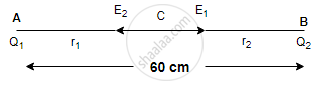
Two-point charges Q1 = 400 μC and Q2 = 100 μC are kept fixed, 60 cm apart in a vacuum. Find the intensity of the electric field at the midpoint of the line joining Q1 and Q2.
Advertisements
उत्तर
`"E"_1 = "Q"_1/(4 piin_0 "r"_1^2)` ... `["Q"_1 = 400mu"C" = 400 xx 10^-6"C"]`
`"E"_2 = "Q"_2/(4 piin_0 "r"_2^2)` ...`["Q"_2 = 100mu"C" = 100 xx 10^-6"C"]`
∴ The resultant electric field
E = E2 - E1
`= "Q"_2/(4 piin_0 "r"_2^2) - "Q"_1/(4 piin_0 "r"_1^2)`
`= 1/(4 piin_0 "r"^2) ... ["Q"_2 - "Q"_1][because "r"_1 = "r"_2 = "r"]`
`=(9 xx 10^9)/(30/100)^2 [400 - 100]xx10^-6`
`= (9xx10^11xx10^-6[3]xx100)/9`
`= 3 xx 10^7 "NC"^-1`
From Q1 to Q2
APPEARS IN
संबंधित प्रश्न
- Define torque acting on a dipole of dipole moment \[\vec{p}\] placed in a uniform electric field \[\vec{E}\] Express it in the vector from and point out the direction along which it acts. Express it in the vector from and point out the direction along which it acts.
- What happens if the field is non-uniform?
- What would happen if the external field
\[\vec{E}\] is increasing (i) parallel to \[\vec{p}\] and (ii) anti-parallel to \[\vec{p}\]?
In which orientation, a dipole placed in a uniform electric field is in (i) stable, (ii) unstable equilibrium?
A uniform electric field is prevailing in X - direction in certain region. The coordinates of points P, Q, and R are (0, 0), (2, 0) and (0, 2) respectively. Which of the following alternatives is true for the potentials at these points?
Electric charges q, q, - 2q are placed at the comers of an equilateral triangle ABC of side l. The magnitude of electric dipole moment of the system is ____________.
An electric dipole is placed at an angle of 30° to a non-uniform electric field. The dipole will experience ________.
A dipole is placed in an electric field as shown. In which direction will it move?

What work must be done to rotate an electric dipole through an angle θ with the electric field, if an electric dipole of moment p is placed in a uniform electric field E with p parallel to E?
For a short dipole, the ratio of the electric field on the axial line to that on the equatorial line (at the same distance r) is:
