Advertisements
Advertisements
प्रश्न
State Gauss’ Law.
Answer the following question briefly and to the point:
State Gauss’ theorem.
Advertisements
उत्तर १
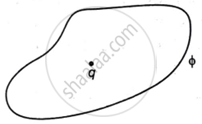
The electric flux (ΦE) through any closed surface is equal to `1/in_0` times the ‘net’ change q enclosed by the surface.
ΦE = `oint vec E d vec A`
= `q/in_0`
∈0 = Permittivity of free space.
उत्तर २
Gauss’ theorem states that the net electric flux over a closed surface is `1/epsilon_0` times the net electric charge enclosed by the surface.
Φ = `oint vec E * d vec A`
= `q/epsilon_0`
संबंधित प्रश्न
"For any charge configuration, equipotential surface through a point is normal to the electric field." Justify.
A point charge of 2.0 μC is at the centre of a cubic Gaussian surface 9.0 cm on edge. What is the net electric flux through the surface?
A point charge causes an electric flux of −1.0 × 10³ Nm2/C to pass through a spherical Gaussian surface of 10.0 cm radius centred on the charge.
- If the radius of the Gaussian surface were doubled, how much flux would pass through the surface?
- What is the value of the point charge?
Obtain the formula for the electric field due to a long thin wire of uniform linear charge density λ without using Gauss’s law. [Hint: Use Coulomb’s law directly and evaluate the necessary integral.]
Find the work done in bringing a charge q from perpendicular distance r1 to r2 (r2 > r1)
Which statement is true for Gauss law -
The electric field inside a spherical shell of uniform surface charge density is ______.
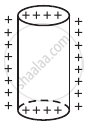
Sketch the electric field lines for a uniformly charged hollow cylinder shown in figure.
- Obtain the expression for the electric field intensity due to a uniformly charged spherical shell of radius R at a point distant r from the centre of the shell outside it.
- Draw a graph showing the variation of electric field intensity E with r, for r > R and r < R.
