Advertisements
Advertisements
Questions
State Gauss’ Law.
Answer the following question briefly and to the point:
State Gauss’ theorem.
Advertisements
Solution 1
The electric flux (ΦE) through any closed surface is equal to `1/in_0` times the ‘net’ change q enclosed by the surface.
ΦE = `oint vec E d vec A`
= `q/in_0`
∈0 = Permittivity of free space.
Solution 2
Gauss’ theorem states that the net electric flux over a closed surface is `1/epsilon_0` times the net electric charge enclosed by the surface.
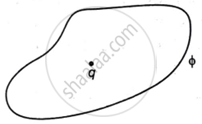
Φ = `oint vec E * d vec A`
= `q/epsilon_0`
RELATED QUESTIONS
Obtain the formula for the electric field due to a long thin wire of uniform linear charge density λ without using Gauss’s law. [Hint: Use Coulomb’s law directly and evaluate the necessary integral.]
If the point charge is now moved to a distance 'd' from the centre of the square and the side of the square is doubled, explain how the electric flux will be affected.
Use Gauss' law to derive the expression for the electric field `(vecE)` due to a straight uniformly charged infinite line of charge density λ C/m.
Draw a graph to show the variation of E with perpendicular distance r from the line of charge.
The electric field intensity outside the charged conducting sphere of radius ‘R’, placed in a medium of permittivity ∈ at a distance ‘r’ from the centre of the sphere in terms of surface charge density σ is
If the ratio of radii of two wires of same material is 3 : 1 and ratio of their lengths is 5 : 1, then the ratio of the normal forces that will produce the same extension in the length of two wires is:
Consider a sphere of radius R with charge density distributed as
ρ(r) = kr for r ≤ R
= 0 for r > R
- Find the electric field at all points r.
- Suppose the total charge on the sphere is 2e where e is the electron charge. Where can two protons be embedded such that the force on each of them is zero. Assume that the introduction of the proton does not alter the negative charge distribution.
- Obtain the expression for the electric field intensity due to a uniformly charged spherical shell of radius R at a point distant r from the centre of the shell outside it.
- Draw a graph showing the variation of electric field intensity E with r, for r > R and r < R.
Draw a graph of kinetic energy as a function of linear charge density λ.
