Advertisements
Advertisements
Question
A closed surface in vacuum encloses charges –q and +3q. The total electric flux emerging out of the surface is :
Options
Zero
`(2q)/∈_0`
`(3q)/∈_0`
`(4q)/∈_0`
Advertisements
Solution
`(2q)/∈_0`
`phi = q_(enc)/∈_0 = (+3q - q)/∈_0 = (2q)/∈_0`
APPEARS IN
RELATED QUESTIONS
A 36 cm long sonometer wire vibrates with frequency of 280 Hz in fundamental mode, when it is under tension of 24.5 N. Calculate linear density of the material of wire.
A point charge of 2.0 μC is at the centre of a cubic Gaussian surface 9.0 cm on edge. What is the net electric flux through the surface?
Obtain the formula for the electric field due to a long thin wire of uniform linear charge density λ without using Gauss’s law. [Hint: Use Coulomb’s law directly and evaluate the necessary integral.]
A point charge q is at a distance of d/2 directly above the centre of a square of side d, as shown the figure. Use Gauss' law to obtain the expression for the electric flux through the square.
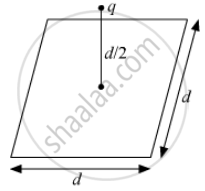
If the point charge is now moved to a distance 'd' from the centre of the square and the side of the square is doubled, explain how the electric flux will be affected.
Draw a graph to show the variation of E with perpendicular distance r from the line of charge.
Through two parallel wires A and B, 10A and 2A of currents are passed respectively in opposite directions. If the wire A is infinitely long and the length of the wire B is 2m, then force on the conductor B, which is situated at 10 cm distance from A, will be:
- Obtain the expression for the electric field intensity due to a uniformly charged spherical shell of radius R at a point distant r from the centre of the shell outside it.
- Draw a graph showing the variation of electric field intensity E with r, for r > R and r < R.
An infinitely long positively charged straight wire has a linear charge density λ. An electron is revolving in a circle with a constant speed v such that the wire passes through the centre, and is perpendicular to the plane, of the circle. Find the kinetic energy of the electron in terms of the magnitudes of its charge and linear charge density λ on the wire.
