English
Karnataka Board PUCPUC Science 2nd PUC Class 12

Obtain the formula for the electric field due to a long thin wire of uniform linear charge density λ without using Gauss’s law. [Hint: Use Coulomb’s law directly and evaluate the necessary integral.] - Physics

Advertisements
Advertisements

Question

Obtain the formula for the electric field due to a long thin wire of uniform linear charge density λ without using Gauss’s law. [Hint: Use Coulomb’s law directly and evaluate the necessary integral.]

Numerical
Advertisements

Solution

Take a long thin wire XY (as shown in the figure) of uniform linear charge density `lambda`.

Consider a point A at a perpendicular distance l from the mid-point O of the wire, as shown in the following figure.
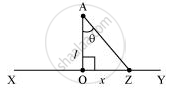
Let E be the electric field at point A due to the wire, XY.

Consider a small length element dx on the wire section with OZ = x

Let q be the charge on this piece.

∴ `"q" = lambda "dx"`

Electric field due to the piece,

`"dE" = 1/(4piin_0)(lambda "dx")/(("AZ")^2)`

However, `"AZ" = sqrt(("l"^2 + "x"^2))`

`"dE"= ( lambda "dx")/(4piin_0("l"^2 + "x"^2))`

The electric field is resolved into two rectangular components. `"dE"cos theta` is the perpendicular component and `"dE"sintheta` is the parallel component.

When the whole wire is considered, the component `"dE"sintheta` is cancelled.

Only the perpendicular component `"dE"cos theta` affects point A.

Hence, effective electric field at point A due to the element dx is dE1.

∴ `"dE"_1 = (lambda"dx" costheta)/(4piin_0("x"^2 + "l"^2))` .............(1)

In `triangle"AZO",`

`tantheta = "x"/"l"`

`"x" = "l" tantheta` ............(2)

On differentiating equation (2), we obtain `("dx")/("d" theta)= "l"sec^2theta`  

`"dx" = "l"sec^2theta "d"theta` ........(3)

From equation (2),

`"x"^2 + "l"^2 = "l"^2 + "l"^2 tan theta`

∴ `"l"^2(1 + tan^2 theta) = "l"^2sec^2theta`

∴ `"x"^2 + "l"^2 = "l"^2sin^2theta` ........(4)

Putting equations (3) and (4) in equation (1), we obtain

∴ `"dE"_1= ( lambda "l" sec^2 "d" theta)/(4piin_0"l"^2sec^2 theta) xx costheta`

∴ `"dE"_1 = (lambda cos theta "d" theta)/(4 pi in_0 "l")` ..............(5)

The wire is so long that `theta` tends from `-pi/2` to `+pi/2`.

By integrating equation (5), we obtain the value of field E1 as,

`int_(-pi/2)^(pi/2) "dE"_1 = int_(-pi/2)^(pi/2)lambda/(4piin_0"l") cos theta "d" theta`

`"E"_1 = lambda/(4piin_0"l")[sin theta]_(-pi/2)^(pi/2)`

= `lambda/(4 pi in_0"l") xx 2`

`"E"_1 = lambda/(2piin_0"l")`

Therefore, the electric field due to long wire is `lambda/(2piin_0"l")`.

shaalaa.com
  Is there an error in this question or solution?

RELATED QUESTIONS

A 36 cm long sonometer wire vibrates with frequency of 280 Hz in fundamental mode, when it is under tension of 24.5 N. Calculate linear density of the material of wire.


Explain why, for a charge configuration, the equipotential surface through a point is normal to the electric field at that point


A point charge q is at a distance of d/2 directly above the centre of a square of side d, as shown the figure. Use Gauss' law to obtain the expression for the electric flux through the square.


If the point charge is now moved to a distance 'd' from the centre of the square and the side of the square is doubled, explain how the electric flux will be affected.


Use Gauss' law to derive the expression for the electric field `(vecE)` due to a straight uniformly charged infinite line of charge density λ C/m.


State Gauss’ Law.


Charge motion within the Gaussian surface gives changing physical quantity ______.

Which statement is true for Gauss law -


A spherical ball contracts in volume by 0.02% when subjected to a pressure of 100 atmosphere. Assuming one atmosphere = 105 Nm−2, the bulk modulus of the material of the ball is:


If the ratio of radii of two wires of same material is 3 : 1 and ratio of their lengths is 5 : 1, then the ratio of the normal forces that will produce the same extension in the length of two wires is:


The electric field inside a spherical shell of uniform surface charge density is ______.


What is the nature of the Gaussian surface involved in the Gauss law of electrostatics?


Sketch the electric field lines for a uniformly charged hollow cylinder shown in figure.


  1. Obtain the expression for the electric field intensity due to a uniformly charged spherical shell of radius R at a point distant r from the centre of the shell outside it.
  2. Draw a graph showing the variation of electric field intensity E with r, for r > R and r < R.

A solid metal sphere of radius R having charge q is enclosed inside the concentric spherical shell of inner radius a and outer radius b as shown in the figure. The approximate variation of the electric field `vecE` as a function of distance r from centre O is given by ______.


An infinitely long positively charged straight wire has a linear charge density λ. An electron is revolving in a circle with a constant speed v such that the wire passes through the centre, and is perpendicular to the plane, of the circle. Find the kinetic energy of the electron in terms of the magnitudes of its charge and linear charge density λ on the wire.


Draw a graph of kinetic energy as a function of linear charge density λ.


Share
Notifications

Englishहिंदीमराठी


      Forgot password?
Use app×