Advertisements
Advertisements
प्रश्न
Drive the expression for electric field at a point on the equatorial line of an electric dipole.
Advertisements
उत्तर
Electric Field for Points on the Equatorial Plane:

The magnitudes of the electric field due to the two charges +q and −q are given by,
`E_(+q)=q/(4piepsilon_0)1/(r^2+a^2)` .....(i)
`E_(-q)=q/(4piepsilon_0)1/(r^2-a^2)` .....(ii)
The directions of E+q and E−q are as shown in the figure. The components normal to the dipole axis cancel away. The components along the dipole axis add up.
∴ Total electric field
`E=-(E_(+q)+E_(-q))cos theta.hatp`[Negative sign shows that field is opposite to `hatp`]
`E=-(2qa)/(4piepsilon_0(r^2+a^2)^(3/2))hatp` .....(iii)
At large distances (r >> a), this reduces to
`E=-(2qa)/(4piepsilon_0(r^3))hatp` .....(iv)
`because vecp=qxxvec(2a)hatp`
`therefore E=(-vecp)/(4piepsilon_0(r^3))` (r >> a)
APPEARS IN
संबंधित प्रश्न
An electric dipole of dipole moment`vecp` consists of point charges +q and −q separated by a distance 2a apart. Deduce the expression for the electric field `vecE` due to the dipole at a distance x from the centre of the dipole on its axial line in terms of the dipole moment `vecp`. Hence show that in the limit x>> a, `vecE->2vecp"/"(4piepsilon_0x^3)`
An electric dipole consists of two opposite charges each 0.05 µC separated by 30 mm. The dipole is placed in an unifom1 external electric field of 106 NC-1. The maximum torque exerted by the field on the dipole is ______
A short electric dipole bas a dipole moment of 16 x 10-9 C m. The electric potential due to the dipole at a point at a distance of 0.6 m from the centre of the dipole, situated on a line making an angle of 60° with the dipole axis is: ____________. `(1/(4piepsilon_0) = 9 xx 10^9 "Nm"^2// "C"^2)`
Electric charges q, q, - 2q are placed at the comers of an equilateral triangle ABC of side l. The magnitude of electric dipole moment of the system is ____________.
Electric dipole consists of two charges of magnitude 0.1 µC separated by a distance of 2 cm. The dipole is in 5 an external field of 105 N/C. What maximum torque does the field exert on the dipole?
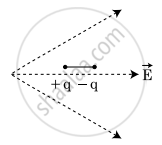
A dipole is placed in an electric field as shown. In which direction will it move?
The electric field in a region is given by `vec"E" = 2/5"E"_0hat"i"+3/5"E"_0hat"j"` with `"E"_0 = 4.0xx10^3 "N"/"C"`. The flux of this field through a rectangular surface area 0.4 m2 parallel to the Y - Z plane is ______ Nm2C-1.
The direction of the dipole axis is defined as the line pointing from:
The dimensional formula for electric dipole moment is:
At a point P on the equatorial line of a dipole, both charges are at equal distances. This distance is expressed as:
