Advertisements
Advertisements
प्रश्न
An electric dipole of length 1 cm, which placed with its axis making an angle of 60° with uniform electric field, experience a torque of \[6\sqrt{3} Nm\] . Calculate the potential energy of the dipole if it has charge ±2 nC.
Advertisements
उत्तर
Torque,
Potential energy,
\[\frac{\tau}{U} = \frac{\left( Ql \right)E\sin\theta}{- \left( Ql \right)E\cos\theta} = - \tan\theta\]
\[ \Rightarrow U = - \frac{\tau}{\tan\theta}\]
\[ \Rightarrow U = - \frac{\tau}{\tan {60}^o}\]
\[ \Rightarrow U = - \frac{6\sqrt{3}}{\sqrt{3}}\]
\[ \Rightarrow U = - 6 J\]
APPEARS IN
संबंधित प्रश्न
Depict the equipotential surfaces due to an electric dipole.
Define electric dipole moment. Is it a scalar or a vector? Derive the expression for the electric field of a dipole at a point on the equatorial plane of the dipole.
Two particles A and B, of opposite charges 2.0 × 10⁻⁶ C and −2.0 × 10⁻⁶ C, are placed at a separation of 1.0 cm. Calculate the electric field at a point on the perpendicular bisector of the dipole and 1.0 m away from the centre.
The unit of electric dipole moment is ______.
An electric dipole of moment p is placed parallel to the uniform electric field. The amount of work done in rotating the dipole by 90° is ____________.
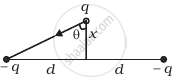
Two charges –q each are fixed separated by distance 2d. A third charge q of mass m placed at the mid-point is displaced slightly by x(x << d) perpendicular to the line joining the two fixed charged as shown in figure. Show that q will perform simple harmonic oscillation of time period.
`T = [(8pi^3 ε_0 md^3)/q^2]^(1/2)`
The electric dipole moment \[\vec{p}\] is defined mathematically as:
In the derivation of the electric field at the equatorial line, why do the components perpendicular to the dipole axis cancel out?
