Advertisements
Advertisements
Question
Two point charges qA = 3 μC and qB = −3 μC are located 20 cm apart in vacuum.
- What is the electric field at the midpoint O of the line AB joining the two charges?
- If a negative test charge of magnitude 1.5 × 10⁻⁹ C is placed at this point, what is the force experienced by the test charge?
Advertisements
Solution
(a)
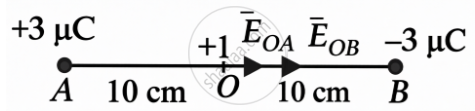
Electric fields at O due to the charges at A and B are:
`E_(OA) = E_(OB) = 1/(4 pi ε_0) q/r^2`
= `9 xx 10^9 xx (3 xx 10^-6 C)/((20xx 10^-2 m)/2)^2`
= `(27 xx 10^3 C)/((10 xx 10^-2 m)^2`
= `(27 xx 10^3 C)/(0.1 m)^2`
= `(27 xx 10^3 C)/(10^-2 m^2)`
or EOA = EOB = 27 × 105 NC−1
Being in the same direction results in a net electric field at the midpoint O, which is:
E = EOA + EOB
= 2EOB
= 2 × 27 × 105
or E = 5.4 × 10⁶ N C−1 directed along OB.
(b) A force acts onto the test charge when it is put at point O, with q0 = −1.5 × 10⁻⁹ C.
F = q0E
= 1.5 × 10−9 × 5.4 × 106
= 8.1 × 10⁻³ N
A long OA, which is opposite to E.
RELATED QUESTIONS
An oil drop of 12 excess electrons is held stationary under a constant electric field of 2.55 × 10⁴ N C−1 (Millikan’s oil drop experiment). The density of the oil is 1.26 g cm−3. Estimate the radius of the drop. (g = 9.81 m s−2; e = 1.60 × 10⁻¹⁹ C).
Can two equipotential surfaces cut each other?
If a charge is placed at rest in an electric field, will its path be along a line of force? Discuss the situation when the lines of force are straight and when they are curved.
If a positive charge is shifted from a low-potential region to a high-potential region, the electric potential energy ______.
Two equal positive charges are kept at points A and B. The electric potential at the points between A and B (excluding these points) is situated while moving from A to B. The potential
If 109 electrons move out of a body to another body every second, how much time is approximately required to get a total charge of 1C on the other body?
Electrostatic force is the force exerted by ______.
The electric field \[\vec{E}\] at a point is defined as the ratio of the electrostatic force \[\vec{F}\] to a vanishingly small positive test charge q₀. What is the SI unit of the electric field?
For static charges at rest, which statement correctly describes the role and characteristics of the electric field?
Electromagnetic waves, such as sunlight or radio signals, transport energy through space from a source to a receiver. What does this phenomenon demonstrate about the nature of electric and magnetic fields?
An accelerated charge generates an electromagnetic wave while a stationary charge generates only a static electric field. What fundamental principle explains this difference in behavior?
An electric field has SI units of N C⁻¹. Express the dimensional relationship between force (F), charge (q₀), and the electric field (E).
