English
Karnataka Board PUCPUC Science 2nd PUC Class 12

a. An electrostatic field line is a continuous curve. That is, a field line cannot have sudden breaks. Why not? b. Explain why two field lines never cross each other at any point? - Physics

Advertisements
Advertisements

Question

  1. An electrostatic field line is a continuous curve. That is, a field line cannot have sudden breaks. Why not?
  2. Explain why two field lines never cross each other at any point?
Answer in Brief
Advertisements

Solution


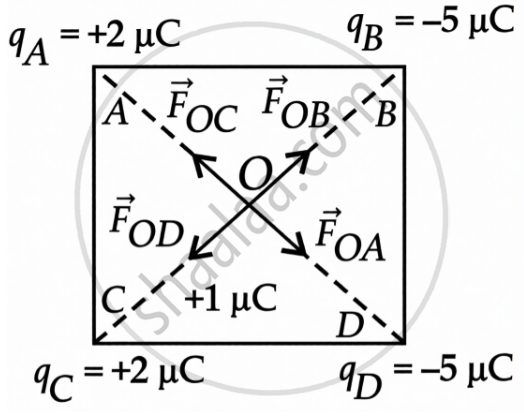
  1. As, `vecF_(OA) = vecF_(OC) or vecF_(OA) + vecF_(OC) = 0`  ...(i)
    Therefore, at zero, the net force on the charge is + 1 µC.
    `vecF = vecF_(OA) + vecF_(OC) + vecF_(OB) + vecF_(OD) or vecF = 0`
    An electrostatic field line is a continuous curve because a charge experiences a continuous force when traced in an electrostatic field. The field line cannot have sudden breaks because the charge moves continuously and does not jump from one point to the other.
  2. If two field lines cross each other at a point, then electric field intensity will show two directions at that point. This is not possible. Hence, two field lines never cross each other.
shaalaa.com
  Is there an error in this question or solution?
Chapter 1: Electric Charge and Fields - EXERCISES [Page 42]

APPEARS IN

NCERT Physics [English] Class 12
Chapter 1 Electric Charge and Fields
EXERCISES | Q 1.7 | Page 42

Video TutorialsVIEW ALL [1]

RELATED QUESTIONS

Why do the electrostatic field lines not form closed loops?


Why do the electric field lines never cross each other?


The figure shows the field lines on a positive charge. Is the work done by the field in moving a small positive charge from Q to P positive or negative? Give reason.


Two bar magnets are quickly moved towards a metallic loop connected across a capacitor ‘C’ as shown in the figure. Predict the polarity of the capacitor.


Draw the pattern of electric field lines, when a point charge –Q is kept near an uncharged conducting plate.


Answer the following question.
Draw the pattern of electric field lines when a point charge +q is kept near an uncharged conducting plate.


Answer the following question.
Derive an expression for the electric field due to a dipole of dipole moment `vec"p"` at a point on its perpendicular bisector.


Explain why two field lines never cross each other at any point?


A point positive charge is brought near an isolated conducting sphere (figure). The electric field is best given by ______.


Figure shows electric field lines in which an electric dipole P is placed as shown. Which of the following statements is correct?


A hollow sphere of charge does not have electric field at ______.

Which of the following figures represent the electric field lines due to a single negative charge?


If Ea be the electric field strength of a short dipole at a point on its axial line and Ee that on the equatorial line at the same distance, then:


In figure, two positive charges q2 and q3 fixed along the y axis, exert a net electric force in the + x direction on a charge q1 fixed along the x-axis. If a positive charge Q is added at (x, 0), the force on q1


(a)

(b)

The magnitude of the electric field due to a point charge object at a distance of 4.0 m is 9 N/C. From the same charged object the electric field of magnitude, 16 N/C will be at a distance of ______.


Share
Notifications

Englishहिंदीमराठी


      Forgot password?
Use app×