Advertisements
Advertisements
Question
Four point charges qA = 2 μC, qB = −5 μC, qC = 2 μC, and qD = −5 μC are located at the corners of a square ABCD of side 10 cm. What is the force on a charge of 1 μC placed at the centre of the square?
Advertisements
Solution
The given figure shows a square of a side 10 cm with four charges placed at its corners. O is the centre of the square.
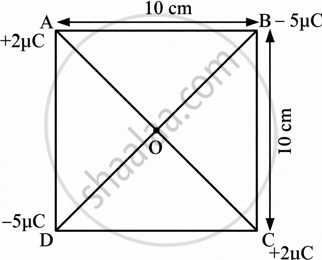
Where,
(Sides) AB = BC = CD = AD = 10 cm
(Diagonals) AC = BD = `10sqrt2`cm
AO = OC = DO = OB = `5sqrt2` cm
A charge of amount 1 μC is placed at point O.
Force of repulsion between charges placed at corner A and centre O is equal in magnitude but opposite in direction relative to the force of repulsion between the charges placed at corner C and centre O. Hence, they will cancel each other. Similarly, the force of attraction between charges placed at corner B and centre O is equal in magnitude but opposite in direction relative to the force of attraction between the charges placed at corner D and centre O. Hence, they will also cancel each other. Therefore, the net force caused by the four charges placed at the corner of the square on 1 μC charge at centre O is zero.
APPEARS IN
RELATED QUESTIONS
Two equal balls with equal positive charge 'q' coulombs are suspended by two insulating strings of equal length. What would be the effect on the force when a plastic sheet is inserted between the two?
Three-point charges q, – 4q and 2q are placed at the vertices of an equilateral triangle ABC of side 'l' as shown in the figure. Obtain the expression for the magnitude of the resultant electric force acting on the charge q

(b) Find out the amount of the work done to separate the charges at infinite distance.
Write any two important points of similarities and differences each between Coulomb's law for the electrostatic field and Biot-Savart's law of the magnetic field ?
Consider a gold nucleus to be a sphere of radius 6.9 fermi in which protons and neutrons are distributed. Find the force of repulsion between two protons situated at largest separation. Why do these protons not fly apart under this repulsion?
NaCl molecule is bound due to the electric force between the sodium and the chlorine ions when one electron of sodium is transferred to chlorine. Taking the separation between the ions to be 2.75 × 10⁻⁸ cm, find the force of attraction between them. State the assumptions (if any) that you have made.
Four equal charges of 2.0 × 10⁻⁶ C each are fixed at the four corners of a square of side 5 cm. Find the Coulomb's force experienced by one of the charges due to the other three.
A particle A with a charge of 2.0 × 10⁻⁶ C and a mass of 100 g is placed at the bottom of a smooth inclined plane of inclination 30°. Where should another particle B, with the same charge and mass, be placed on the incline so that it may remain in equilibrium?
Two identical particles, each with a charge of 2.0 × 10⁻⁴ C and mass of 10 g, are kept at a separation of 10 cm and then released. What would be the speed of the particles when the separation becomes large?
The force between two charges 0.06 m apart is 5 N. If each charge is moved towards the other by 0.01 m, then the force between them will become ______.
The electric force acting between two point charges kept at a certain distance in vacuum is 16 N. If the same two charges are kept at the same distance in a medium of dielectric constant 8, the electric force acting between them is ____________ N.
For charges q1 and q2 separated by a distance R the magnitude of the electrostatic force is given by ______.
A charge Q is divided into two parts of q and Q – q. If the coulomb repulsion between them when they are separated is to be maximum, the ratio of Q/q should be ______.
The capacity of an isolate conducting sphere of radius R is proportional to
According to Coulomb's law, which is the correct relation for the following figure?

Two point charges Q each are placed at a distance d apart. A third point charge q is placed at a distance x from the mid-point on the perpendicular bisector. The value of x at which charge q will experience the maximum Coulomb's force is ______.
Four charges equal to −Q are placed at the four a corners of a square and charge q is at its centre. If the system is in equilibrium, the value of q is ______.
What is meant by the statement: "Relative permittivity of water is 81"?
