हिंदी
कर्नाटक बोर्ड पी.यू.सी.पीयूसी विज्ञान 2nd PUC Class 12

Four point charges qA = 2 μC, qB = −5 μC, qC = 2 μC, and qD = −5 μC are located at the corners of a square ABCD of side 10 cm. What is the force on a charge of 1 μC placed at the centre of the square? - Physics

Advertisements
Advertisements

प्रश्न

Four point charges q= 2 μC, q= −5 μC, qC = 2 μC, and qD = −5 μC are located at the corners of a square ABCD of side 10 cm. What is the force on a charge of 1 μC placed at the centre of the square?

संख्यात्मक
Advertisements

उत्तर

The given figure shows a square of a side 10 cm with four charges placed at its corners. O is the centre of the square.
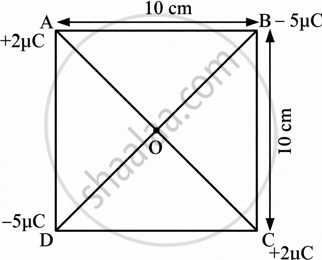
Where,

(Sides) AB = BC = CD = AD = 10 cm

(Diagonals) AC = BD = `10sqrt2`cm

AO = OC = DO = OB = `5sqrt2` cm

A charge of amount 1 μC is placed at point O.

Force of repulsion between charges placed at corner A and centre O is equal in magnitude but opposite in direction relative to the force of repulsion between the charges placed at corner C and centre O. Hence, they will cancel each other. Similarly, the force of attraction between charges placed at corner B and centre O is equal in magnitude but opposite in direction relative to the force of attraction between the charges placed at corner D and centre O. Hence, they will also cancel each other. Therefore, the net force caused by the four charges placed at the corner of the square on 1 μC charge at centre O is zero.

shaalaa.com
  क्या इस प्रश्न या उत्तर में कोई त्रुटि है?
अध्याय 1: Electric Charge and Fields - EXERCISES [पृष्ठ ४२]

APPEARS IN

एनसीईआरटी Physics [English] Class 12
अध्याय 1 Electric Charge and Fields
EXERCISES | Q 1.6 | पृष्ठ ४२

संबंधित प्रश्न

Two equal balls with equal positive charge 'q' coulombs are suspended by two insulating strings of equal length. What would be the effect on the force when a plastic sheet is inserted between the two?


Three-point charges q, – 4q and 2q are placed at the vertices of an equilateral triangle ABC of side 'l' as shown in the figure. Obtain the expression for the magnitude of the resultant electric force acting on the charge q

(b) Find out the amount of the work done to separate the charges at infinite distance.


Four charges +q, −q, +q and −q are to be arranged respectively at the four corners of a square ABCD of side 'a'.
(a) Find the work required to put together this arrangement.
(b) A charge q0 is brought to the centre of the square, the four charges being held fixed. How much extra work is needed to do this ?


Two charges 2.0 × 10⁻⁶ C and 1.0 × 10⁻⁶ C are placed at a separation of 10 cm. Where should a third charge be placed, such that it experiences no net force due to these charges?


Suppose all the electrons of 100 g water are lumped together to form a negatively-charged particle and all the nuclei are lumped together to form a positively-charged particle. If these two particles are placed 10.0 cm away from each other, find the force of attraction between them. Compare it with your weight.


Two insulating small spheres are rubbed against each other and placed 1 cm apart. If they attract each other with a force of 0.1 N, how many electrons were transferred from one sphere to the other during rubbing?


Suppose an attractive nuclear force acts between two protons which may be written as F=Ce−kr/r2. Write down the dimensional formulae and appropriate SI units of C and k.   


Three equal charges, 2.0 × 106 C each, are held at the three corners of an equilateral triangle of side 5 cm. Find the Coulomb force experienced by one of the charges due to the other two.  


Four equal charges of 2.0 × 10⁻⁶ C each are fixed at the four corners of a square of side 5 cm. Find the Coulomb's force experienced by one of the charges due to the other three. 


Two identical balls, each with a charge of 2.00 × 10⁻⁷ C and a mass of 100 g, are suspended from a common point by two insulating strings, each 50 cm long. The balls are held at a separation 5.0 cm apart and then released. Find. 

(a) the electric force on one of the charged balls

(b) the components of the resultant force on it along and perpendicular to the string

(c) the tension in the string

(d) the acceleration of one of the balls. Answers are to be obtained only for the instant just after the release.


Two particles A and B possessing charges of +2.00 × 10⁻⁶ C and of −4.00 × 10⁻⁶ C, respectively, are held fixed at a separation of 20.0 cm. Locate the points (s) on the line AB, where (a) the electric field is zero (b) the electric potential is zero.  


Three identical charges, each with a value of 1.0 × 10⁻⁸ C, are placed at the corners of an equilateral triangle of side 20 cm. Find the electric field and potential at the centre of the triangle. 


Two equal charges, 2.0 × 10⁻⁷ C each, are held fixed at a separation of 20 cm. A third charge of equal magnitude is placed midway between the two charges. It is now moved to a point 20 cm from both the charges. How much work is done by the electric field during the process?


How much work has to be done in assembling three charged particles at the vertices of an equilateral triangle, as shown in the figure?


Solve numerical example.

Three equal charges of 10×10-8 C respectively, each located at the corners of a right triangle whose sides are 15 cm, 20 cm, and 25cm respectively. Find the force exerted on the charge located at the 90° angle.


A force F acts between sodium and chlorine ions of salt (sodium chloride) when put 1 cm apart in air. The permittivity of air and dielectric constant of water are `epsilon_0` and K respectively. When a piece of salt is put in water, electrical force acting between sodium and chlorine ions 1 cm apart is ____________.


A total charge Q is broken in two parts Q1 and Q2 and they are placed at a distance R from each other. The maximum force of repulsion between them will occur, when ____________.


A spring of spring constant 5 × 10³ N/m is stretched initially by 5 cm from the unstretched position. Then the work required to stretch it further by another 5 cm is:


According to Coulomb's law, which is the correct relation for the following figure?


Share
Notifications

Englishहिंदीमराठी


      Forgot password?
Use app×