Advertisements
Advertisements
Question
An electric dipole is placed in an electric field generated by a point charge.
Options
The net electric force on the dipole must be zero.
The net electric force on the dipole may be zero.
The torque on the dipole due to the field must be zero.
The torque on the dipole due to the field may be zero.
Advertisements
Solution
The torque on the dipole due to the field may be zero.
Torque acting on a dipole placed in an electric field,
\[\tau = r \times F\]
\[ = rF\sin\theta,\]
where θ is the angle between the force F and the arm of the couple.
So, for θ = 0 or pi ,the torque will be zero. Hence, the amount of torque acting on the dipole depends on the orientation of the dipole in the given electric field.
APPEARS IN
RELATED QUESTIONS
A short electric dipole (which consists of two point charges, +q and -q) is placed at the centre 0 and inside a large cube (ABCDEFGH) of length L, as shown in Figure 1. The electric flux, emanating through the cube is:
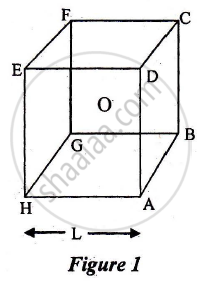
a) `q"/"4piin_9L`
b) zero
c) `q"/"2piin_0L`
d) `q"/"3piin_0L`
- Define torque acting on a dipole of dipole moment \[\vec{p}\] placed in a uniform electric field \[\vec{E}\] Express it in the vector from and point out the direction along which it acts. Express it in the vector from and point out the direction along which it acts.
- What happens if the field is non-uniform?
- What would happen if the external field
\[\vec{E}\] is increasing (i) parallel to \[\vec{p}\] and (ii) anti-parallel to \[\vec{p}\]?
Write the expression for the torque \[\vec{\tau}\] acting on a dipole of dipole moment \[\vec{p}\] placed in an electric field \[\vec{E}\].
Two-point charges Q1 = 400 μC and Q2 = 100 μC are kept fixed, 60 cm apart in a vacuum. Find the intensity of the electric field at the midpoint of the line joining Q1 and Q2.
An electric dipole consists of two opposite charges each 0.05 µC separated by 30 mm. The dipole is placed in an unifom1 external electric field of 106 NC-1. The maximum torque exerted by the field on the dipole is ______
On the axis and on the equator of an electric dipole for all points ____________.
A short electric dipole bas a dipole moment of 16 x 10-9 C m. The electric potential due to the dipole at a point at a distance of 0.6 m from the centre of the dipole, situated on a line making an angle of 60° with the dipole axis is: ____________. `(1/(4piepsilon_0) = 9 xx 10^9 "Nm"^2// "C"^2)`
The unit of electric dipole moment is ______.
An electric dipole of moment `vec"p"` is placed normal to the lines of force of electric intensity `vec"E"`, then the work done in deflecting it through an angle of 180° is:
The region surrounding a stationary electric dipole has ______
A dipole is placed in an electric field as shown. In which direction will it move?

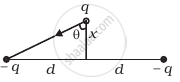
Two charges –q each are fixed separated by distance 2d. A third charge q of mass m placed at the mid-point is displaced slightly by x(x << d) perpendicular to the line joining the two fixed charged as shown in figure. Show that q will perform simple harmonic oscillation of time period.
`T = [(8pi^3 ε_0 md^3)/q^2]^(1/2)`
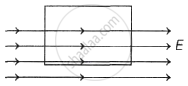
A square surface of side l (m) in the plane of the paper. A uniform electric field E(V/m) also in the plane of the paper is limited only to the lower half of the square surface, the electric flux (in SI units) associated with the surface is ______.
The SI unit of electric dipole moment is:
The direction of the electric field on the equatorial line of a dipole is:
On the equatorial line of a dipole (θ = 90°), the electric potential is:
How does the electric potential due to a dipole vary with distance compared to that of a point charge?
Hydrogen chloride (HCl) has a large dipole moment because:
For the configuration with +0.25 μC at (0, 0, −15 cm) and −0.25 μC at (0, 0, +15 cm), the direction of the dipole moment is:
