Advertisements
Advertisements
प्रश्न
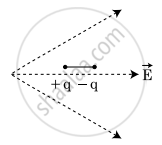
An electric dipole is placed in an electric field generated by a point charge.
पर्याय
The net electric force on the dipole must be zero.
The net electric force on the dipole may be zero.
The torque on the dipole due to the field must be zero.
The torque on the dipole due to the field may be zero.
Advertisements
उत्तर
The torque on the dipole due to the field may be zero.
Torque acting on a dipole placed in an electric field,
\[\tau = r \times F\]
\[ = rF\sin\theta,\]
where θ is the angle between the force F and the arm of the couple.
So, for θ = 0 or pi ,the torque will be zero. Hence, the amount of torque acting on the dipole depends on the orientation of the dipole in the given electric field.
APPEARS IN
संबंधित प्रश्न
An electric dipole of length 4 cm, when placed with its axis making an angle of 60° with a uniform electric field, experiences a torque of `4sqrt3`Nm. Calculate the potential energy of the dipole, if it has charge ±8 nC
An electric dipole is placed at the centre of a sphere. Mark the correct options.
(a) The flux of the electric field through the sphere is zero.
(b) The electric field is zero at every point of the sphere.
(c) The electric field is not zero anywhere on the sphere.
(d) The electric field is zero on a circle on the sphere.
A sample of HCI gas is placed in an electric field of 2.5 × 10⁴ NC−1. The dipole moment of each HCI molecule is 3.4 × 10⁻³⁰ Cm. Find the maximum torque that can act on a molecule.
Two particles A and B, of opposite charges 2.0 × 10⁻⁶ C and −2.0 × 10⁻⁶ C, are placed at a separation of 1.0 cm. Calculate the electric field at a point on the axis of the dipole 1.0 cm away from the centre.
Three charges are arranged on the vertices of an equilateral triangle, as shown in the figure. Find the dipole moment of the combination.
A uniform electric field is prevailing in X - direction in certain region. The coordinates of points P, Q, and R are (0, 0), (2, 0) and (0, 2) respectively. Which of the following alternatives is true for the potentials at these points?
Two charges + 3.2 x 10⁻¹⁹ C and --3.2 x 10⁻¹⁹ C placed at 2.4 Å apart to form an electric dipole. lt is placed in a uniform electric field of intensity 4 x 10⁵ volt/m. The electric dipole moment is ______.
A metal sphere of radius 1 cm is given a charge of 3.14 µC. Find the electric intensity at a distance of 1 m from the centre of sphere.
`[epsilon_0 = 8.85 xx 10^-12 "F"//m]`
The electric field at a point on the equatorial plane at a distance r from the centre of a dipole having dipole moment `vec "p"` is given by, (r >> separation of two charges forming the dipole, `epsilon_0 - ` permittivity of free space) ____________.
On the axis and on the equator of an electric dipole for all points ____________.
An electric dipole is placed at an angle of 30° to a non-uniform electric field. The dipole will experience ________.
A dipole is placed in an electric field as shown. In which direction will it move?

A dipole is placed in an electric field as shown. In which direction will it move?
The midpoint of the line joining the negative and positive charges in an electric dipole is called the:
The direction of the dipole axis is defined as the line pointing from:
The electric dipole moment \[\vec{p}\] is defined mathematically as:
Carbon dioxide (CO₂) has zero net dipole moment even though it contains polar C=O bonds. Why?
