Advertisements
Advertisements
प्रश्न
Two particles A and B, of opposite charges 2.0 × 10⁻⁶ C and −2.0 × 10⁻⁶ C, are placed at a separation of 1.0 cm. Calculate the electric field at a point on the perpendicular bisector of the dipole and 1.0 m away from the centre.
Advertisements
उत्तर
Given:
Magnitude of charge, q = 2.0 × 10⁻⁶ C
Separation between the charges, l = 1.0 cm
Electric field at at a point on the perpendicular bisector of the dipole,
\[E = \frac{1}{4\pi \epsilon_0}\frac{P}{r '^3}\]
\[E = \frac{9 \times {10}^9 \times 2 \times {10}^{- 8}}{1^3}\]
E = 180 N/C
APPEARS IN
संबंधित प्रश्न
An electric dipole of dipole moment`vecp` consists of point charges +q and −q separated by a distance 2a apart. Deduce the expression for the electric field `vecE` due to the dipole at a distance x from the centre of the dipole on its axial line in terms of the dipole moment `vecp`. Hence show that in the limit x>> a, `vecE->2vecp"/"(4piepsilon_0x^3)`
An electric dipole of length 4 cm, when placed with its axis making an angle of 60° with a uniform electric field, experiences a torque of `4sqrt3`Nm. Calculate the potential energy of the dipole, if it has charge ±8 nC
Drive the expression for electric field at a point on the equatorial line of an electric dipole.
Derive an expression for the intensity of electric field at a point in broadside position or on [4)
an equatorial line of an electric dipole.
Write the expression for the torque \[\vec{\tau}\] acting on a dipole of dipole moment \[\vec{p}\] placed in an electric field \[\vec{E}\].
Three charges are arranged on the vertices of an equilateral triangle, as shown in the figure. Find the dipole moment of the combination.
Two-point charges Q1 = 400 μC and Q2 = 100 μC are kept fixed, 60 cm apart in a vacuum. Find the intensity of the electric field at the midpoint of the line joining Q1 and Q2.
The unit of electric dipole moment is ______.
An electric dipole of moment p is placed parallel to the uniform electric field. The amount of work done in rotating the dipole by 90° is ____________.
The ratio of the weight of a man in a stationary lift and in a lift accelerating downwards with a uniform acceleration α is 3 : 2. The acceleration of the lift is:
The region surrounding a stationary electric dipole has ______
Polar molecules are the molecules ______.
Polar molecules are the molecules ______.
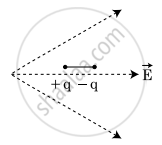
A dipole is placed in an electric field as shown. In which direction will it move?
The electric potential V as a function of distance X is shown in the figure.
The graph of the magnitude of electric field intensity E as a function of X is ______.
Arrangement of an oxygen ion and two hydrogen ions in a water molecule is shown in the figure below.
Calculate the electric dipole moment of a water molecule. Express your answer in terms of e (charge on hydrogen ions), l and θ.

The dimensional formula for electric dipole moment is:
For a short dipole at a point P on the equatorial line, where r ≫ a, the electric field is given by:
On the axial line of a dipole (θ = 0°), the electric potential is:
