Advertisements
Advertisements
प्रश्न
Three charges are arranged on the vertices of an equilateral triangle, as shown in the figure. Find the dipole moment of the combination.
Advertisements
उत्तर
The system can be considered as a combination of two dipoles making an angle of 60∘ with each other.
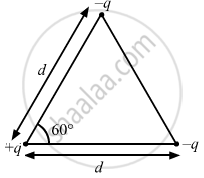
Length of each dipole = d
So, the dipole moment, P = q × d
So, the resultant dipole moment,
\[P_{net} = \sqrt{P^2 + P^2 + 2P\cos60^\circ}\]
\[ = \sqrt{(qd )^2 + (qd )^2 + 2 \left( qd \right)^2 \cos60^\circ}\]
\[ = [ d^2 q^2 + d^2 q^2 + 2 q^2 d^2 \times \frac{1}{2} ]^{1/2} \]
\[ = [3 q^2 d^2 ]^{1/2} = \sqrt{3}qd\]
The net dipole moment is along the bisector of the angle at +q, away from the triangle.
Notes
Figure is missing in the question .
APPEARS IN
संबंधित प्रश्न
- Define torque acting on a dipole of dipole moment \[\vec{p}\] placed in a uniform electric field \[\vec{E}\] Express it in the vector from and point out the direction along which it acts. Express it in the vector from and point out the direction along which it acts.
- What happens if the field is non-uniform?
- What would happen if the external field
\[\vec{E}\] is increasing (i) parallel to \[\vec{p}\] and (ii) anti-parallel to \[\vec{p}\]?
Define dipole moment of an electric dipole. Is it a scalar or a vector?
An electric dipole is placed in an electric field generated by a point charge.
Two particles A and B, of opposite charges 2.0 × 10⁻⁶ C and −2.0 × 10⁻⁶ C, are placed at a separation of 1.0 cm.
Two-point charges Q1 = 400 μC and Q2 = 100 μC are kept fixed, 60 cm apart in a vacuum. Find the intensity of the electric field at the midpoint of the line joining Q1 and Q2.
Answer the following question.
Derive an expression for the electric field at any point on the equatorial line of an electric dipole.
An electric dipole consists of two opposite charges each 0.05 µC separated by 30 mm. The dipole is placed in an unifom1 external electric field of 106 NC-1. The maximum torque exerted by the field on the dipole is ______
An electric dipole is placed at an angle of 30° with an electric field intensity of 2 × 10⁵ N/C. It experiences a torque equal to 4 Nm. The charge on the dipole, if the dipole length is 2 cm, is ______.
A uniform electric field is prevailing in X - direction in certain region. The coordinates of points P, Q, and R are (0, 0), (2, 0) and (0, 2) respectively. Which of the following alternatives is true for the potentials at these points?
A metal sphere of radius 1 cm is given a charge of 3.14 µC. Find the electric intensity at a distance of 1 m from the centre of sphere.
`[epsilon_0 = 8.85 xx 10^-12 "F"//m]`
The electric field at a point on the equatorial plane at a distance r from the centre of a dipole having dipole moment `vec "p"` is given by, (r >> separation of two charges forming the dipole, `epsilon_0 - ` permittivity of free space) ____________.
A short electric dipole bas a dipole moment of 16 x 10-9 C m. The electric potential due to the dipole at a point at a distance of 0.6 m from the centre of the dipole, situated on a line making an angle of 60° with the dipole axis is: ____________. `(1/(4piepsilon_0) = 9 xx 10^9 "Nm"^2// "C"^2)`
The unit of electric dipole moment is ______.
In a non-uniform electric field, electric dipole experiences:-
The electric potential V as a function of distance X is shown in the figure.
The graph of the magnitude of electric field intensity E as a function of X is ______.
Eight dipoles of charges of magnitude e each are placed inside a cube. The total electric flux coming out of the cube will be ______.
In an electric dipole, what is the locus of a point having zero potential?
