Advertisements
Advertisements
प्रश्न
Two particles A and B, of opposite charges 2.0 × 10⁻⁶ C and −2.0 × 10⁻⁶ C, are placed at a separation of 1.0 cm. Calculate the electric field at a point on the axis of the dipole 1.0 cm away from the centre.
Advertisements
उत्तर
Given:
Magnitude of charge, q = 2.0 × 10⁻⁶ C
Separation between the charges, l = 1.0 m
Electric field at the axial point of the dipole,
\[E = \frac{1}{4\pi \epsilon_0}\frac{2P}{r^3}\]
\[E = \frac{9 \times {10}^9 \times 2 \times 2 \times {10}^{- 8}}{\left( 1 \right)^3}\]
E = 36 × 10
= 360 N/C
APPEARS IN
संबंधित प्रश्न
An electric dipole of length 4 cm, when placed with its axis making an angle of 60° with a uniform electric field, experiences a torque of `4sqrt3`Nm. Calculate the potential energy of the dipole, if it has charge ±8 nC
Depict the orientation of the dipole in (i) stable, (ii) unstable equilibrium in a uniform electric field.
Define electric dipole moment. Is it a scalar or a vector? Derive the expression for the electric field of a dipole at a point on the equatorial plane of the dipole.
Three charges are arranged on the vertices of an equilateral triangle, as shown in the figure. Find the dipole moment of the combination.
Two particles, carrying charges −q and +q and and of mass m each, are fixed at the ends of a light rod of length a to form a dipole. The rod is clamped at an end and is placed in a uniform electric field E with the axis of the dipole along the electric field. The rod is slightly tilted and then released. Neglecting gravity, find the time period of small oscillations.
Answer the following question.
Derive an expression for the electric field at any point on the equatorial line of an electric dipole.
Answer the following question.
What is the unit of dipole moment?
Dimensions of mass in electric field and in electric dipole moment are respectively.
The electric field at a point on the equatorial plane at a distance r from the centre of a dipole having dipole moment `vec "p"` is given by, (r >> separation of two charges forming the dipole, `epsilon_0 - ` permittivity of free space) ____________.
A short electric dipole bas a dipole moment of 16 x 10-9 C m. The electric potential due to the dipole at a point at a distance of 0.6 m from the centre of the dipole, situated on a line making an angle of 60° with the dipole axis is: ____________. `(1/(4piepsilon_0) = 9 xx 10^9 "Nm"^2// "C"^2)`
An electric dipole is placed at an angle of 30° to a non-uniform electric field. The dipole will experience ________.
A conic surface is placed in a uniform electric field E as shown in the figure such that the field is perpendicular to the surface on the side AB. The base of the cone is of radius R, and the height of the cone is h. The angle of the cone is θ.
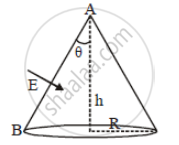
Find the magnitude of the flux that enters the cone's curved surface from the left side. Do not count the outgoing flux (θ < 45°)
The ratio of the weight of a man in a stationary lift and in a lift accelerating downwards with a uniform acceleration α is 3 : 2. The acceleration of the lift is:
The region surrounding a stationary electric dipole has ______
What work must be done to rotate an electric dipole through an angle θ with the electric field, if an electric dipole of moment p is placed in a uniform electric field E with p parallel to E?
Show that intensity of electric field at a point in broadside position of an electric dipole is given by:
E = `(1/(4 pi epsilon_0)) p/((r^2 + l^2)^(3//2))`
Where the terms have their usual meaning.
In an electric dipole, what is the locus of a point having zero potential?
An electric dipole consists of charges +q and −q separated by a distance 2a. Which of the following statements about the dipole is correct?
Hydrogen chloride (HCl) has a large dipole moment because:
