Advertisements
Advertisements
प्रश्न
An electric dipole is placed at the centre of a sphere. Mark the correct options.
(a) The flux of the electric field through the sphere is zero.
(b) The electric field is zero at every point of the sphere.
(c) The electric field is not zero anywhere on the sphere.
(d) The electric field is zero on a circle on the sphere.
Advertisements
उत्तर
(a) The flux of the electric field through the sphere is zero.
(c) The electric field is not zero anywhere on the sphere.
The sphere encloses a dipole, i.e. two equal and opposite charges. In other words, net charge enclosed in the sphere is zero. Hence, the flux is zero through the sphere.
But the electric field at any point p on the sphere,
`"E" = 1/(4piε_0) "p"/"r"^3 sqrt(3 cos^2 theta +1)`,where θ is the angle made by the point p with the centre of the dipole.
Hence, we can see that the field is not zero anywhere on the sphere.
APPEARS IN
संबंधित प्रश्न
A short electric dipole (which consists of two point charges, +q and -q) is placed at the centre 0 and inside a large cube (ABCDEFGH) of length L, as shown in Figure 1. The electric flux, emanating through the cube is:
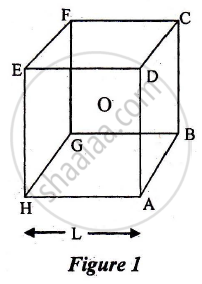
a) `q"/"4piin_9L`
b) zero
c) `q"/"2piin_0L`
d) `q"/"3piin_0L`
Derive an expression for the intensity of electric field at a point in broadside position or on [4)
an equatorial line of an electric dipole.
Find the resultant electric field due to an electric dipole of dipole moment, 2aq, (2a being the separation between the charges ±± q) at a point distant 'x' on its equator.
Define electric dipole moment.
Two particles A and B, of opposite charges 2.0 × 10⁻⁶ C and −2.0 × 10⁻⁶ C, are placed at a separation of 1.0 cm. Calculate the electric field at a point on the perpendicular bisector of the dipole and 1.0 m away from the centre.
Two particles, carrying charges −q and +q and and of mass m each, are fixed at the ends of a light rod of length a to form a dipole. The rod is clamped at an end and is placed in a uniform electric field E with the axis of the dipole along the electric field. The rod is slightly tilted and then released. Neglecting gravity, find the time period of small oscillations.
Answer the following question.
Derive an expression for the electric field at any point on the equatorial line of an electric dipole.
Answer the following question.
What is the unit of dipole moment?
An electric dipole consists of two opposite charges each 0.05 µC separated by 30 mm. The dipole is placed in an unifom1 external electric field of 106 NC-1. The maximum torque exerted by the field on the dipole is ______
An electric dipole is placed at an angle of 30° with an electric field intensity of 2 × 10⁵ N/C. It experiences a torque equal to 4 Nm. The charge on the dipole, if the dipole length is 2 cm, is ______.
An electric dipole of moment p is placed parallel to the uniform electric field. The amount of work done in rotating the dipole by 90° is ____________.
The region surrounding a stationary electric dipole has ______
In an electric dipole, what is the locus of a point having zero potential?
An electric dipole consists of charges +q and −q separated by a distance 2a. Which of the following statements about the dipole is correct?
The potential energy of a dipole in an external electric field is given by:
When a dipole is aligned with the external electric field (θ = 0°), the potential energy is:
Water (H₂O) exhibits a dipole moment of approximately 1.85 D. The primary reason is:
