Advertisements
Advertisements
प्रश्न
Two particles A and B, of opposite charges 2.0 × 10⁻⁶ C and −2.0 × 10⁻⁶ C, are placed at a separation of 1.0 cm. Two particles A and B, of opposite charges 2.0 × 10⁻⁶ C and −2.0 × 10⁻⁶ C, are placed at a separation of 1.0 cm.
Advertisements
उत्तर
Given:
Magnitude of charge, q = 2.0 × 10⁻⁶ C
Separation between the charges, l = 1.0 cm
Dipole moment, P = q × l
P = 2 × 10−6 × 10−2
= 2 × 10⁻⁸ C
APPEARS IN
संबंधित प्रश्न
Drive the expression for electric field at a point on the equatorial line of an electric dipole.
- Define torque acting on a dipole of dipole moment \[\vec{p}\] placed in a uniform electric field \[\vec{E}\] Express it in the vector from and point out the direction along which it acts. Express it in the vector from and point out the direction along which it acts.
- What happens if the field is non-uniform?
- What would happen if the external field
\[\vec{E}\] is increasing (i) parallel to \[\vec{p}\] and (ii) anti-parallel to \[\vec{p}\]?
Define dipole moment of an electric dipole. Is it a scalar or a vector?
Define electric dipole moment.
In which orientation, a dipole placed in a uniform electric field is in (i) stable, (ii) unstable equilibrium?
Two particles A and B, of opposite charges 2.0 × 10⁻⁶ C and −2.0 × 10⁻⁶ C, are placed at a separation of 1.0 cm. Calculate the electric field at a point on the perpendicular bisector of the dipole and 1.0 m away from the centre.
Three charges are arranged on the vertices of an equilateral triangle, as shown in the figure. Find the dipole moment of the combination.
Answer the following question.
Derive an expression for the electric field at any point on the equatorial line of an electric dipole.
Answer the following question.
What is the unit of dipole moment?
An electric dipole consists of two opposite charges each 0.05 µC separated by 30 mm. The dipole is placed in an unifom1 external electric field of 106 NC-1. The maximum torque exerted by the field on the dipole is ______
An electric dipole is placed at an angle of 30° with an electric field intensity of 2 × 10⁵ N/C. It experiences a torque equal to 4 Nm. The charge on the dipole, if the dipole length is 2 cm, is ______.
On the axis and on the equator of an electric dipole for all points ____________.
Electric charges q, q, - 2q are placed at the comers of an equilateral triangle ABC of side l. The magnitude of electric dipole moment of the system is ____________.
An electric dipole is placed at an angle of 30° to a non-uniform electric field. The dipole will experience ________.
A conic surface is placed in a uniform electric field E as shown in the figure such that the field is perpendicular to the surface on the side AB. The base of the cone is of radius R, and the height of the cone is h. The angle of the cone is θ.
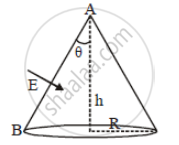
Find the magnitude of the flux that enters the cone's curved surface from the left side. Do not count the outgoing flux (θ < 45°)
The unit of electric dipole moment is ______.
The electric intensity due to a dipole of length 10 cm and having a charge of 500 µC, at a point on the axis at a distance 20 cm from one of the charges in air, is:
An electric dipole of moment `vec"p"` is placed normal to the lines of force of electric intensity `vec"E"`, then the work done in deflecting it through an angle of 180° is:
In a non-uniform electric field, electric dipole experiences:-
