Advertisements
Advertisements
प्रश्न
Find the resultant electric field due to an electric dipole of dipole moment, 2aq, (2a being the separation between the charges ±± q) at a point distant 'x' on its equator.
Advertisements
उत्तर
Consider a dipole consisting of two electric charges +q and −q between a small distance AB = 2a with centre O.
Now, let us find the electric field intensity at point P.
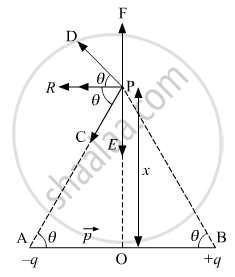
The magnitudes of the electric field at point P due to the two charges +q and −q are given by
`E_(+q) = q/(4πε_0) 1/(x^2+a^2) .....(1)`
and ` E_(-q) = q/(4πε_0) 1/(x^2+a^2) ...... (2)`
`∴ E_(+q) = E_(-q) `
The directions of E+q and E−q are as shown in the figure. The components normal to the dipole axis along PE and PF cancel away. The components along the dipole axis add up.
Therefore, the resultant electric field at point P is given as
`E = - (E_(+q) + E_(-q) cosΘ)` (The negative sign shows that the field is opposite to the dipole moment of the dipole.)
`E=(-2qa)/(4πε_0 (x^2+a^2)^(3/2)) ......(3)`
When point P lies at a large distance (x >> a) from the dipole, the above expression reduces to
`E = (-2qa)/(4πε_0 x^3 ) ....... (4)`
∴ `p =1 xx 2a`
∴ `E = (-p)/(4πε_0 x^3 )` (x >> a)
The direction of this electric field is along PR (or BA).
APPEARS IN
संबंधित प्रश्न
Depict the equipotential surfaces due to an electric dipole.
An electric dipole is placed at the centre of a sphere. Mark the correct options.
(a) The flux of the electric field through the sphere is zero.
(b) The electric field is zero at every point of the sphere.
(c) The electric field is not zero anywhere on the sphere.
(d) The electric field is zero on a circle on the sphere.
An electric dipole consists of two opposite charges each 0.05 µC separated by 30 mm. The dipole is placed in an unifom1 external electric field of 106 NC-1. The maximum torque exerted by the field on the dipole is ______
An electric dipole is placed at an angle of 30° with an electric field intensity of 2 × 10⁵ N/C. It experiences a torque equal to 4 Nm. The charge on the dipole, if the dipole length is 2 cm, is ______.
When an electric dipole p is placed in a uniform electric field E then at what angle the value of torque will be maximum?
The ratio of the weight of a man in a stationary lift and in a lift accelerating downwards with a uniform acceleration α is 3 : 2. The acceleration of the lift is:
In a non-uniform electric field, electric dipole experiences:-
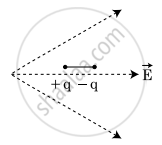
A dipole is placed in an electric field as shown. In which direction will it move?
When a dipole is anti-aligned with the external electric field (θ = 180°), the potential energy is:
On the equatorial line of a dipole (θ = 90°), the electric potential is:
