Advertisements
Advertisements
प्रश्न
Consider a system of n charges q1, q2, ... qn with position vectors `vecr_1,vecr_2,vecr_3,...... vecr_n`relative to some origin 'O'. Deduce the expression for the net electric field`vec E` at a point P with position vector `vecr_p,`due to this system of charges.
Advertisements
उत्तर
Let us consider a system of n charges q1, q2, ... qn with position vectors r1, r2, r3, ...rn relative to origin O.
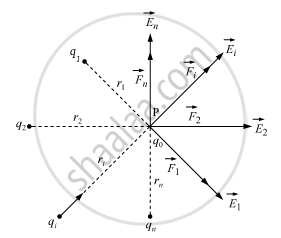
Let `vecF_i` be the force due to ith charge qi on q0.
Then,
`vecF_i = 1/(4πε_0) (q_1q_0)/(r_i^2) \ hat r_i`
Here, ri is the distance of the test charge q0 from qi.
The electric field at the observation point P is given by `vecE_i = lim_(q0->0) vecF_i/(q_0) = lim _(q0->0) 1/q_0 (1/(4πε_0) (q_1q_0)/r_1^2 hatr_i)`
`vecE_i = 1/(4πε_0) q_i/(r_1^2)hat r_i ........ (1) `
If `vecE` is the electric field at point P due to the system of charges, then by the principle of superposition of electric fields,
`vecE = vecE_1 +vecE_2 +vecE_3 +....vecE_n = sum_(i=1)^n vecE_i`
Using (1), we get
`vecE = sum_(i=1)^n 1/(4πε_0)q_i/(r_i^2)hat r_i `
`vecE =1/(4πε_0) sum_(i=1)^n q_i/(r_i^2)hat r_i`
APPEARS IN
संबंधित प्रश्न
The charge on a proton is +1.6 × 10⁻¹⁹ C and that on an electron is −1.6 × 10⁻¹⁹ C. Does it mean that the electron has 3.2 × 10⁻¹⁹ C less charge than the proton?
The electric field at the origin is along the positive x-axis. A small circle is drawn with the centre at the origin, cutting the axes at points A, B, C and D with coordinates (a, 0), (0, a), (−a, 0), (0, −a), respectively. Out of the points on the periphery of the circle, the potential is minimum at
If a body is charged by rubbing it, its weight
The electric field and the electric potential at a point are E and V, respectively.
Electric potential decreases uniformly from 120 V to 80 V, as one moves on the x-axis from x = −1 cm to x = +1 cm. The electric field at the origin
(a) must be equal to 20 Vcm−1
(b) may be equal to 20 Vcm−1
(c) may be greater than 20 Vcm−1
(d) may be less than 20 Vcm−1
12 J of work has to be done against an existing electric field to take a charge of 0.01 C from A to B. How much is the potential difference VB − VA?
An electric field of 20 NC−1 exists along the x-axis in space. Calculate the potential difference VB − VA where the points A and B are
(a) A = (0, 0); B = (4 m, 2m)
(b) A = (4 m, 2 m); B = (6 m, 5 m)
(c) A = (0, 0); B = (6 m, 5 m)
Do you find any relation between the answers of parts (a), (b) and (c)?
Two identical blocks are kept on a frictionless horizontal table connected by a spring of stiffness k and of original length l0. A total charge Q is distributed on the block such that maximum elongation of spring at equilibrium is equal to x. Value of Q is ______.
When 1014 electrons are removed from a neutral metal sphere, the charge on the sphere becomes ______.
Two similar spheres having +Q and -Q charges are kept at a certain distance. F force acts between the two. If at the middle of two spheres, another similar sphere having +Q charge is kept, then it experiences a force in magnitude and direction as ______.
