Advertisements
Advertisements
प्रश्न
Consider a system of n charges q1, q2, ... qn with position vectors `vecr_1,vecr_2,vecr_3,...... vecr_n`relative to some origin 'O'. Deduce the expression for the net electric field`vec E` at a point P with position vector `vecr_p,`due to this system of charges.
Advertisements
उत्तर
Let us consider a system of n charges q1, q2, ... qn with position vectors r1, r2, r3, ...rn relative to origin O.
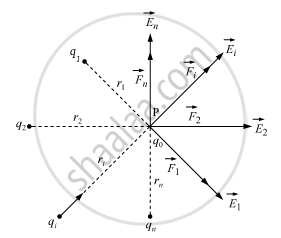
Let `vecF_i` be the force due to ith charge qi on q0.
Then,
`vecF_i = 1/(4πε_0) (q_1q_0)/(r_i^2) \ hat r_i`
Here, ri is the distance of the test charge q0 from qi.
The electric field at the observation point P is given by `vecE_i = lim_(q0->0) vecF_i/(q_0) = lim _(q0->0) 1/q_0 (1/(4πε_0) (q_1q_0)/r_1^2 hatr_i)`
`vecE_i = 1/(4πε_0) q_i/(r_1^2)hat r_i ........ (1) `
If `vecE` is the electric field at point P due to the system of charges, then by the principle of superposition of electric fields,
`vecE = vecE_1 +vecE_2 +vecE_3 +....vecE_n = sum_(i=1)^n vecE_i`
Using (1), we get
`vecE = sum_(i=1)^n 1/(4πε_0)q_i/(r_i^2)hat r_i `
`vecE =1/(4πε_0) sum_(i=1)^n q_i/(r_i^2)hat r_i`
APPEARS IN
संबंधित प्रश्न
Why does a phonograph record attract dust particles just after it is cleaned?
In some old texts it is mentioned that 4π lines of force originate from each unit positive charge. Comment on the statement in view of the fact that 4π is not an integer.
The electric field in a region is directed outward and is proportional to the distance rfrom the origin. Taking the electric potential at the origin to be zero,
A wire is bent in the form of a regular hexagon and a total charge q is distributed uniformly on it. What is the electric field at the centre? You may answer this part without making any numerical calculations.
A ball of mass 100 g and with a charge of 4.9 × 10⁻⁵ C is released from rest in a region where a horizontal electric field of 2.0 × 10⁴ N C−1 exists. (a) Find the resultant force acting on the ball. (b) What will be the path of the ball? (c) Where will the ball be at the end of 2 s?
Which of the following methods can be used to charge a metal sphere positively without touching it? Select the most appropriate.
Consider a region inside which, there are various types of charges but the total charge is zero. At points outside the region ______.
For a system of n point charges, what is the mathematical expression for the total electric field at point P?
Which key point best describes how each individual electric field is calculated in a system of multiple charges?
