Advertisements
Advertisements
प्रश्न
Show that if we connect the smaller and the outer sphere by a wire, the charge q on the former will always flow to the latter, independent of how large the charge Q is.
Advertisements
उत्तर
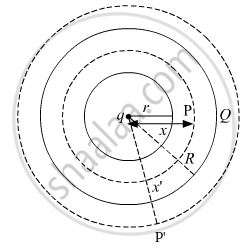
To calculate the electric field intensity at any point P', where point P' lies outside of the spherical shell, imagine a Gaussian surface with centre O and radius x', as shown in the figure given above.
According to Gauss's theorem,
` E' xx 4πx^'2 = (q+Q)/ε_0 `
⇒`E = (q+Q)/(4πx'^ 2 )`
As the charge always resides only on the outer surface of a conduction shell, the charge flows essentially from the sphere to the shell when they are connected by a wire. It does not depend on the magnitude and sign of charge Q.
APPEARS IN
संबंधित प्रश्न
Why does a phonograph record attract dust particles just after it is cleaned?
Consider a uniformly charged ring of radius R. Find the point on the axis where the electric field is maximum.
An electric field of 20 NC−1 exists along the x-axis in space. Calculate the potential difference VB − VA where the points A and B are
(a) A = (0, 0); B = (4 m, 2m)
(b) A = (4 m, 2 m); B = (6 m, 5 m)
(c) A = (0, 0); B = (6 m, 5 m)
Do you find any relation between the answers of parts (a), (b) and (c)?
The surface charge density of a thin charged disc of radius R is σ. The value of the electric field at the center of the disc is `sigma/(2∈_0)`. With respect to the field at the center, the electric field along the axis at a distance R from the center of the disc ______.
In general, metallic ropes are suspended on the carriers taking inflammable materials. The reason is ______.
Two similar spheres having +Q and -Q charges are kept at a certain distance. F force acts between the two. If at the middle of two spheres, another similar sphere having +Q charge is kept, then it experiences a force in magnitude and direction as ______.
The Electric field at a point is ______.
- always continuous.
- continuous if there is no charge at that point.
- discontinuous only if there is a negative charge at that point.
- discontinuous if there is a charge at that point.
What does the Principle of Superposition state regarding the electric field at a point due to a group of charges?
Which key point best describes how each individual electric field is calculated in a system of multiple charges?
