Advertisements
Advertisements
प्रश्न
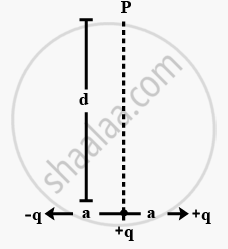
Find the magnitude of the electric field at the point P in the configuration shown in the figure for d >> a.
Advertisements
उत्तर
Taking
\[\text{ So}, E = E_1 \cos \theta + E_2 cos\theta\]
\[ = E_1 cos\theta + E_2 cos\theta\]
\[ = 2 E_1 \cos \theta\]
\[ = 2 . \frac{1}{4\pi \in_0} . \frac{qa}{( d^2 + a^2 )^{3/2}}\]
\[ = \frac{1}{4\pi \in_0} . \frac{p}{d^3} [\text{ since } a < < d]\]
Notes
Figure is missing in the question .
APPEARS IN
संबंधित प्रश्न
The charge on a proton is +1.6 × 10⁻¹⁹ C and that on an electron is −1.6 × 10⁻¹⁹ C. Does it mean that the electron has 3.2 × 10⁻¹⁹ C less charge than the proton?
Why does a phonograph record attract dust particles just after it is cleaned?
The electric field at the origin is along the positive x-axis. A small circle is drawn with the centre at the origin, cutting the axes at points A, B, C and D with coordinates (a, 0), (0, a), (−a, 0), (0, −a), respectively. Out of the points on the periphery of the circle, the potential is minimum at
A point charge q is rotated along a circle in an electric field generated by another point charge Q. The work done by the electric field on the rotating charge in one complete revolution is
The electric field in a region is directed outward and is proportional to the distance rfrom the origin. Taking the electric potential at the origin to be zero,
Consider a uniformly charged ring of radius R. Find the point on the axis where the electric field is maximum.
A wire is bent in the form of a regular hexagon and a total charge q is distributed uniformly on it. What is the electric field at the centre? You may answer this part without making any numerical calculations.
A particle of mass m and charge q is thrown at a speed u against a uniform electric field E. How much distance will it travel before coming to momentary rest ?
A particle of mass 1 g and charge 2.5 × 10⁻⁴ C is released from rest in an electric field of 1.2 × 10 4 N C−1. What will be the speed of the particle after travelling this distance?
12 J of work has to be done against an existing electric field to take a charge of 0.01 C from A to B. How much is the potential difference VB − VA?
An electric field of 20 NC−1 exists along the x-axis in space. Calculate the potential difference VB − VA where the points A and B are
(a) A = (0, 0); B = (4 m, 2m)
(b) A = (4 m, 2 m); B = (6 m, 5 m)
(c) A = (0, 0); B = (6 m, 5 m)
Do you find any relation between the answers of parts (a), (b) and (c)?
The kinetic energy of a charged particle decreases by 10 J as it moves from a point at potential 100 V to a point at potential 200 V. Find the charge on the particle.
The electric field intensity produced by the radiations coming from 100 W bulb at 3 m distance is E. The electric field intensity produced by the radiations coming from 50 W bulb at the same distance is:
What does the Principle of Superposition state regarding the electric field at a point due to a group of charges?
According to the procedure for calculating electric field due to a system of charges, what is the first step?
What does the symbol ε₀ represent in the electric field formula?
