Advertisements
Advertisements
प्रश्न
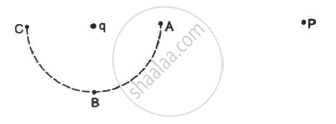
A point charge q is rotated along a circle in an electric field generated by another point charge Q. The work done by the electric field on the rotating charge in one complete revolution is
विकल्प
zero
positive
negative
zero if the charge Q is at the centre, otherwise non-zero
Advertisements
उत्तर
zero
The electrostatic field is conservative and the work done by the field is a state function, i.e. it only depends on the initial and final positions of the charge but not on the path followed by it. In completing one revolution, the charge has the same initial and final positions. Therefore, the work done by the field on rotating the charge in one complete revolution is zero.
APPEARS IN
संबंधित प्रश्न
Show that if we connect the smaller and the outer sphere by a wire, the charge q on the former will always flow to the latter, independent of how large the charge Q is.
Can a gravitational field be added vectorially to an electric field to get a total field?
If a body is charged by rubbing it, its weight
Consider the situation in the figure. The work done in taking a point charge from P to Ais WA, from P to B is WB and from P to C is WC.
The electric field in a region is directed outward and is proportional to the distance rfrom the origin. Taking the electric potential at the origin to be zero,
Consider a uniformly charged ring of radius R. Find the point on the axis where the electric field is maximum.
A wire is bent in the form of a regular hexagon and a total charge q is distributed uniformly on it. What is the electric field at the centre? You may answer this part without making any numerical calculations.
A particle of mass 1 g and charge 2.5 × 10⁻⁴ C is released from rest in an electric field of 1.2 × 10 4 N C−1. How long will it take for the particle to travel a distance of 40 cm?
Which of the following methods can be used to charge a metal sphere positively without touching it? Select the most appropriate.
The surface charge density of a thin charged disc of radius R is σ. The value of the electric field at the center of the disc is `sigma/(2∈_0)`. With respect to the field at the center, the electric field along the axis at a distance R from the center of the disc ______.
In general, metallic ropes are suspended on the carriers taking inflammable materials. The reason is ______.
Two similar spheres having +Q and -Q charges are kept at a certain distance. F force acts between the two. If at the middle of two spheres, another similar sphere having +Q charge is kept, then it experiences a force in magnitude and direction as ______.
The Electric field at a point is ______.
- always continuous.
- continuous if there is no charge at that point.
- discontinuous only if there is a negative charge at that point.
- discontinuous if there is a charge at that point.
What does the Principle of Superposition state regarding the electric field at a point due to a group of charges?
According to the procedure for calculating electric field due to a system of charges, what is the first step?
In the electric field formula, what does the symbol \[\hat r_i\]P represent?
