Advertisements
Advertisements
प्रश्न
The electric field in a region is directed outward and is proportional to the distance rfrom the origin. Taking the electric potential at the origin to be zero,
विकल्प
it is uniform in the region
it is proportional to r
it is proportional to r2
it increases as one moves away from the origin
Advertisements
उत्तर
it is proportional to r2
Given:
E \[\propto\] r and V = 0 at r =0
⇒ E = kr
Also, E = \[\frac{- dV}{dr}\]
\[\therefore V = - \int Edr\]
\[ \Rightarrow V = - \int krdr\]
\[ \Rightarrow V = - k\frac{r^2}{2} + C\]
Using the condition, V = 0 at r = 0, we get C =0.
Therefore,
\[V = - k\frac{r^2}{2}\]
\[ \Rightarrow V \propto r^2\]
APPEARS IN
संबंधित प्रश्न
An infinite line charge produces a field of 9 × 10⁴ N/C at a distance of 2 cm. Calculate the linear charge density.
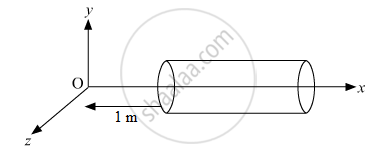
A hollow cylindrical box of length 0.5 m and area of cross-section 25 cm2 is placed in a three dimensional coordinate system as shown in the figure. The electric field in the region is given by `vecE = 20 xhati` where E is NC−1 and x is in metres. Find
(i) Net flux through the cylinder.
(ii) Charge enclosed by the cylinder.
Can a gravitational field be added vectorially to an electric field to get a total field?
When the separation between two charges is increased, the electric potential energy of the charges
A 10-cm long rod carries a charge of +50 μC distributed uniformly along its length. Find the magnitude of the electric field at a point 10 cm from both ends of the rod.
Consider a uniformly charged ring of radius R. Find the point on the axis where the electric field is maximum.
12 J of work has to be done against an existing electric field to take a charge of 0.01 C from A to B. How much is the potential difference VB − VA?
Consider the situation of the previous problem. A charge of −2.0 × 10⁻⁴ C is moved from point A to point B. Find the change in electrical potential energy UB − UA for the cases (a), (b) and (c).
Assume that each atom in a copper wire contributes one free electron. Estimate the number of free electrons in a copper wire of mass 6.4 g (take the atomic weight of copper to be 64 g mol−1).
The surface charge density of a thin charged disc of radius R is σ. The value of the electric field at the center of the disc is `sigma/(2∈_0)`. With respect to the field at the center, the electric field along the axis at a distance R from the center of the disc ______.
Consider a region inside which, there are various types of charges but the total charge is zero. At points outside the region ______.
The Electric field at a point is ______.
- always continuous.
- continuous if there is no charge at that point.
- discontinuous only if there is a negative charge at that point.
- discontinuous if there is a charge at that point.
What is the value and unit of Coulomb's constant \[\frac{1}{4\pi\varepsilon_0}\]?
