Advertisements
Advertisements
प्रश्न
A particle of mass 1 g and charge 2.5 × 10⁻⁴ C is released from rest in an electric field of 1.2 × 10 4 N C−1. How much is the work done by the electric force on the particle during this period?
Advertisements
उत्तर
Given:
Charge of the particle, q = 2.5 × 10⁻⁴ C
Initial velocity, u = 0
Electric field intensity, E = 1.2 × 10⁴ N/C
Mass of the particle, m = 1 g = 10−3 kg
Distance travelled, s = 40 cm = 4 × 10⁻¹ m
Work done by the electric force,
\[W = F_e s = 3 \times 4 \times {10}^{- 1} \]
\[ = 12 \times {10}^{- 1} \] J = 1 . 20 J
APPEARS IN
संबंधित प्रश्न
Can a gravitational field be added vectorially to an electric field to get a total field?
Why does a phonograph record attract dust particles just after it is cleaned?
When the separation between two charges is increased, the electric potential energy of the charges
The electric field and the electric potential at a point are E and V, respectively.
Electric potential decreases uniformly from 120 V to 80 V, as one moves on the x-axis from x = −1 cm to x = +1 cm. The electric field at the origin
(a) must be equal to 20 Vcm−1
(b) may be equal to 20 Vcm−1
(c) may be greater than 20 Vcm−1
(d) may be less than 20 Vcm−1
A 10-cm long rod carries a charge of +50 μC distributed uniformly along its length. Find the magnitude of the electric field at a point 10 cm from both ends of the rod.
A block of mass m with a charge q is placed on a smooth horizontal table and is connected to a wall through an unstressed spring of spring constant k, as shown in the figure. A horizontal electric field E, parallel to the spring, is switched on. Find the amplitude of the resulting SHM of the block. 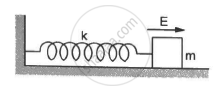
Consider the situation of the previous problem. A charge of −2.0 × 10⁻⁴ C is moved from point A to point B. Find the change in electrical potential energy UB − UA for the cases (a), (b) and (c).
The electric potential existing in space is \[\hspace{0.167em} V(x, y, z) = A(xy + yz + zx) .\] (a) Write the dimensional formula of A. (b) Find the expression for the electric field. (c) If A is 10 SI units, find the magnitude of the electric field at (1 m, 1 m, 1 m).
The kinetic energy of a charged particle decreases by 10 J as it moves from a point at potential 100 V to a point at potential 200 V. Find the charge on the particle.
Two identical blocks are kept on a frictionless horizontal table connected by a spring of stiffness k and of original length l0. A total charge Q is distributed on the block such that maximum elongation of spring at equilibrium is equal to x. Value of Q is ______.
Consider a region inside which, there are various types of charges but the total charge is zero. At points outside the region ______.
When 1014 electrons are removed from a neutral metal sphere, the charge on the sphere becomes ______.
The electric field intensity produced by the radiations coming from 100 W bulb at 3 m distance is E. The electric field intensity produced by the radiations coming from 50 W bulb at the same distance is:
What does the Principle of Superposition state regarding the electric field at a point due to a group of charges?
For a system of n point charges, what is the mathematical expression for the total electric field at point P?
What does the symbol ε₀ represent in the electric field formula?
What is the value and unit of Coulomb's constant \[\frac{1}{4\pi\varepsilon_0}\]?
