Advertisements
Advertisements
प्रश्न
Electric potential decreases uniformly from 120 V to 80 V, as one moves on the x-axis from x = −1 cm to x = +1 cm. The electric field at the origin
(a) must be equal to 20 Vcm−1
(b) may be equal to 20 Vcm−1
(c) may be greater than 20 Vcm−1
(d) may be less than 20 Vcm−1
Advertisements
उत्तर
(b) may be equal to 20 Vcm−1
(c) may be greater than 20 Vcm−1
Change in the electric potential, dV = 40 V
Change in length, \[∆ r\] = −1−1 = −2 cm
Electric field, \[E = \frac{- dV}{dr}\]
\[\Rightarrow E = - \frac{40 V}{- 2}\]
\[ \Rightarrow E = 20 {Vcm}^{- 1}\]
This is the value of the electric field along the x axis.
Electric field is maximum along the direction in which the potential decreases at the maximum rate. But here, direction in which the potential decreases at the maximum rate may or may not be along the x-axis. From the given information,the direction of maximum decrease in potential cannot be found out accurately. So, E can be greater than 20 V/cm in the direction of maximum decrease in potential.
So, the electric field at the origin may be equal to or greater than 20 Vcm−1.
APPEARS IN
संबंधित प्रश्न
An infinite line charge produces a field of 9 × 10⁴ N/C at a distance of 2 cm. Calculate the linear charge density.
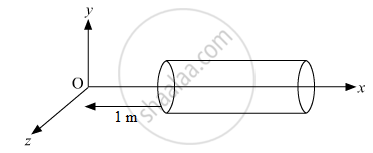
A hollow cylindrical box of length 1 m and area of cross-section 25 cm2 is placed in a three dimensional coordinate system as shown in the figure. The electric field in the region is given by `vecE = 50xhati` where E is NC−1 and x is in metres. Find
(i) Net flux through the cylinder.
(ii) Charge enclosed by the cylinder.
In some old texts it is mentioned that 4π lines of force originate from each unit positive charge. Comment on the statement in view of the fact that 4π is not an integer.
When the separation between two charges is increased, the electric potential energy of the charges
Which of the following quantities does not depend on the choice of zero potential or zero potential energy?
A particle of mass 1 g and charge 2.5 × 10⁻⁴ C is released from rest in an electric field of 1.2 × 10 4 N C−1. Find the electric force and the force of gravity acting on this particle. Can one of these forces be neglected in comparison with the other for approximate analysis?
A particle of mass 1 g and charge 2.5 × 10⁻⁴ C is released from rest in an electric field of 1.2 × 10 4 N C−1. What will be the speed of the particle after travelling this distance?
A ball of mass 100 g and with a charge of 4.9 × 10⁻⁵ C is released from rest in a region where a horizontal electric field of 2.0 × 10⁴ N C−1 exists. (a) Find the resultant force acting on the ball. (b) What will be the path of the ball? (c) Where will the ball be at the end of 2 s?
Consider the situation of the previous problem. A charge of −2.0 × 10⁻⁴ C is moved from point A to point B. Find the change in electrical potential energy UB − UA for the cases (a), (b) and (c).
An electric field \[\vec{E} = ( \vec{i} 20 + \vec{j} 30) {NC}^{- 1}\] exists in space. If the potential at the origin is taken to be zero, find the potential at (2 m, 2 m).
The kinetic energy of a charged particle decreases by 10 J as it moves from a point at potential 100 V to a point at potential 200 V. Find the charge on the particle.
Two identical blocks are kept on a frictionless horizontal table connected by a spring of stiffness k and of original length l0. A total charge Q is distributed on the block such that maximum elongation of spring at equilibrium is equal to x. Value of Q is ______.
Consider a region inside which, there are various types of charges but the total charge is zero. At points outside the region ______.
Two similar spheres having +Q and -Q charges are kept at a certain distance. F force acts between the two. If at the middle of two spheres, another similar sphere having +Q charge is kept, then it experiences a force in magnitude and direction as ______.
For a system of n point charges, what is the mathematical expression for the total electric field at point P?
What is the value and unit of Coulomb's constant \[\frac{1}{4\pi\varepsilon_0}\]?
Which key point best describes how each individual electric field is calculated in a system of multiple charges?
