Advertisements
Advertisements
प्रश्न
The electric field and the electric potential at a point are E and V, respectively.
विकल्प
If E = 0, V must be zero.
If V = 0, E must be zero.
If E ≠ 0, V cannot be zero.
If V ≠0, E cannot be zero.
None of the above.
Advertisements
उत्तर
None of the above.
Electric field, \[E = \frac{- dV}{dr}\] where V = electric potential
For E = 0, V should be constant.
So, when E = 0, it is not necessary that V should be 0.
Hence, none of the above signifies the correct relation.
APPEARS IN
संबंधित प्रश्न
Show that if we connect the smaller and the outer sphere by a wire, the charge q on the former will always flow to the latter, independent of how large the charge Q is.
Consider a system of n charges q1, q2, ... qn with position vectors `vecr_1,vecr_2,vecr_3,...... vecr_n`relative to some origin 'O'. Deduce the expression for the net electric field`vec E` at a point P with position vector `vecr_p,`due to this system of charges.
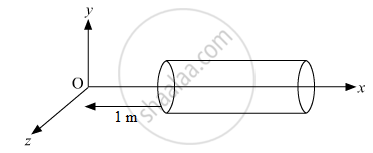
A hollow cylindrical box of length 1 m and area of cross-section 25 cm2 is placed in a three dimensional coordinate system as shown in the figure. The electric field in the region is given by `vecE = 50xhati` where E is NC−1 and x is in metres. Find
(i) Net flux through the cylinder.
(ii) Charge enclosed by the cylinder.
The charge on a proton is +1.6 × 10⁻¹⁹ C and that on an electron is −1.6 × 10⁻¹⁹ C. Does it mean that the electron has 3.2 × 10⁻¹⁹ C less charge than the proton?
When the separation between two charges is increased, the electric potential energy of the charges
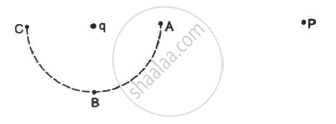
Consider the situation in the figure. The work done in taking a point charge from P to Ais WA, from P to B is WB and from P to C is WC.
Consider a uniformly charged ring of radius R. Find the point on the axis where the electric field is maximum.
A wire is bent in the form of a regular hexagon and a total charge q is distributed uniformly on it. What is the electric field at the centre? You may answer this part without making any numerical calculations.
A particle of mass 1 g and charge 2.5 × 10⁻⁴ C is released from rest in an electric field of 1.2 × 10 4 N C−1. What will be the speed of the particle after travelling this distance?
A ball of mass 100 g and with a charge of 4.9 × 10⁻⁵ C is released from rest in a region where a horizontal electric field of 2.0 × 10⁴ N C−1 exists. (a) Find the resultant force acting on the ball. (b) What will be the path of the ball? (c) Where will the ball be at the end of 2 s?
An electric field \[\vec{E} = \vec{i}\] Ax exists in space, where A = 10 V m−2. Take the potential at (10 m, 20 m) to be zero. Find the potential at the origin.
Find the magnitude of the electric field at the point P in the configuration shown in the figure for d >> a.
Consider a region inside which, there are various types of charges but the total charge is zero. At points outside the region ______.
What does the symbol ε₀ represent in the electric field formula?
Which key point best describes how each individual electric field is calculated in a system of multiple charges?
