Advertisements
Advertisements
प्रश्न
The kinetic energy of a charged particle decreases by 10 J as it moves from a point at potential 100 V to a point at potential 200 V. Find the charge on the particle.
Advertisements
उत्तर
By work-energy theorem,
Change in K.E. = Amount of work done
Change in K.E. = 10 J
Let the charge on the particle be q.
Change in potential,
Work done = \[∆ V \times q\]
\[ \Rightarrow q = \frac{10}{100} = 0 . 1 C\]
APPEARS IN
संबंधित प्रश्न
Show that if we connect the smaller and the outer sphere by a wire, the charge q on the former will always flow to the latter, independent of how large the charge Q is.
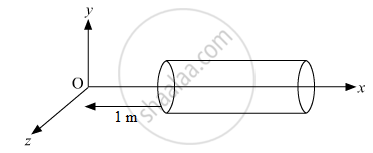
A hollow cylindrical box of length 1 m and area of cross-section 25 cm2 is placed in a three dimensional coordinate system as shown in the figure. The electric field in the region is given by `vecE = 50xhati` where E is NC−1 and x is in metres. Find
(i) Net flux through the cylinder.
(ii) Charge enclosed by the cylinder.
Can a gravitational field be added vectorially to an electric field to get a total field?
In some old texts it is mentioned that 4π lines of force originate from each unit positive charge. Comment on the statement in view of the fact that 4π is not an integer.
The electric field at the origin is along the positive x-axis. A small circle is drawn with the centre at the origin, cutting the axes at points A, B, C and D with coordinates (a, 0), (0, a), (−a, 0), (0, −a), respectively. Out of the points on the periphery of the circle, the potential is minimum at
Consider a uniformly charged ring of radius R. Find the point on the axis where the electric field is maximum.
A block of mass m with a charge q is placed on a smooth horizontal table and is connected to a wall through an unstressed spring of spring constant k, as shown in the figure. A horizontal electric field E, parallel to the spring, is switched on. Find the amplitude of the resulting SHM of the block. 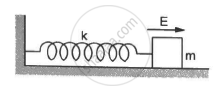
An electric field \[\vec{E} = \vec{i}\] Ax exists in space, where A = 10 V m−2. Take the potential at (10 m, 20 m) to be zero. Find the potential at the origin.
Assume that each atom in a copper wire contributes one free electron. Estimate the number of free electrons in a copper wire of mass 6.4 g (take the atomic weight of copper to be 64 g mol−1).
Consider a region inside which, there are various types of charges but the total charge is zero. At points outside the region ______.
The electric field intensity produced by the radiations coming from 100 W bulb at 3 m distance is E. The electric field intensity produced by the radiations coming from 50 W bulb at the same distance is:
The Electric field at a point is ______.
- always continuous.
- continuous if there is no charge at that point.
- discontinuous only if there is a negative charge at that point.
- discontinuous if there is a charge at that point.
What does the Principle of Superposition state regarding the electric field at a point due to a group of charges?
What does the symbol ε₀ represent in the electric field formula?
What is the value and unit of Coulomb's constant \[\frac{1}{4\pi\varepsilon_0}\]?
In the electric field formula, what does the symbol \[\hat r_i\]P represent?
Which key point best describes how each individual electric field is calculated in a system of multiple charges?
