Advertisements
Advertisements
प्रश्न
A ball of mass 100 g and with a charge of 4.9 × 10⁻⁵ C is released from rest in a region where a horizontal electric field of 2.0 × 10⁴ N C−1 exists. (a) Find the resultant force acting on the ball. (b) What will be the path of the ball? (c) Where will the ball be at the end of 2 s?
Advertisements
उत्तर
Given:
Charge of the ball, q = 4.9 × 10⁻⁵ C
Electrical field intensity, E = 2 × 10⁴ N/C
Mass of the ball, m = 100 gm
Force of gravity, Fg = mg
Electrical force, Fe = Eq
The particle moves due to the resultant force of Fg and Fe.
\[R^2 = {F_g}^2 + {F_e}^2 \]
\[ = (0 . 1 \times 9 . 8 )^2 + (4 . 9 \times {10}^{- 5} \times 2 \times {10}^4 )^2 \]
\[ = 0 . 9604 + 96 . 04 \times {10}^{- 2} \]
\[ = 1 . 9208 N\]
\[ \Rightarrow R = 1 . 3859 N\]
Fg = Fe
⇒ tanθ = 1
⇒ θ = 45°
θ is the angle made by the horizontal with the resultant.
Hence, the path of the ball is straight and is along the resultant force at an angle of 45° with the horizontal
Vertical displacement in t = 2 s,
\[y = \frac{1}{2}g t^2 \]
\[ \Rightarrow y = \frac{1}{2} \times 9 . 8 \times 2 \times 2 = 19 . 6 \] m
Both the forces are same.
So, vertical displacement in 2 s = Horizontal displacement in 2 s
Net displacement
\[= \sqrt{\left( 19 . 6 \right)^2 + \left( 19 . 6 \right)^2} = \sqrt{768 . 932} = 27 . 7 \] m
APPEARS IN
संबंधित प्रश्न
Show that if we connect the smaller and the outer sphere by a wire, the charge q on the former will always flow to the latter, independent of how large the charge Q is.
Consider a system of n charges q1, q2, ... qn with position vectors `vecr_1,vecr_2,vecr_3,...... vecr_n`relative to some origin 'O'. Deduce the expression for the net electric field`vec E` at a point P with position vector `vecr_p,`due to this system of charges.
The charge on a proton is +1.6 × 10⁻¹⁹ C and that on an electron is −1.6 × 10⁻¹⁹ C. Does it mean that the electron has 3.2 × 10⁻¹⁹ C less charge than the proton?
Can a gravitational field be added vectorially to an electric field to get a total field?
When the separation between two charges is increased, the electric potential energy of the charges
Which of the following quantities does not depend on the choice of zero potential or zero potential energy?
The electric field in a region is directed outward and is proportional to the distance rfrom the origin. Taking the electric potential at the origin to be zero,
Consider a uniformly charged ring of radius R. Find the point on the axis where the electric field is maximum.
A particle of mass m and charge q is thrown at a speed u against a uniform electric field E. How much distance will it travel before coming to momentary rest ?
12 J of work has to be done against an existing electric field to take a charge of 0.01 C from A to B. How much is the potential difference VB − VA?
Assume that each atom in a copper wire contributes one free electron. Estimate the number of free electrons in a copper wire of mass 6.4 g (take the atomic weight of copper to be 64 g mol−1).
The surface charge density of a thin charged disc of radius R is σ. The value of the electric field at the center of the disc is `sigma/(2∈_0)`. With respect to the field at the center, the electric field along the axis at a distance R from the center of the disc ______.
Consider a region inside which, there are various types of charges but the total charge is zero. At points outside the region ______.
The electric field intensity produced by the radiations coming from 100 W bulb at 3 m distance is E. The electric field intensity produced by the radiations coming from 50 W bulb at the same distance is:
The Electric field at a point is ______.
- always continuous.
- continuous if there is no charge at that point.
- discontinuous only if there is a negative charge at that point.
- discontinuous if there is a charge at that point.
Five charges, q each are placed at the corners of a regular pentagon of side ‘a’ (Figure).
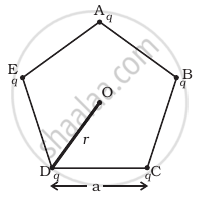
(a) (i) What will be the electric field at O, the centre of the pentagon?
(ii) What will be the electric field at O if the charge from one of the corners (say A) is removed?
(iii) What will be the electric field at O if the charge q at A is replaced by –q?
(b) How would your answer to (a) be affected if pentagon is replaced by n-sided regular polygon with charge q at each of its corners?
What is the value and unit of Coulomb's constant \[\frac{1}{4\pi\varepsilon_0}\]?
Which key point best describes how each individual electric field is calculated in a system of multiple charges?
