Advertisements
Advertisements
Question
The electric field in a region is directed outward and is proportional to the distance rfrom the origin. Taking the electric potential at the origin to be zero,
Options
it is uniform in the region
it is proportional to r
it is proportional to r2
it increases as one moves away from the origin
Advertisements
Solution
it is proportional to r2
Given:
E \[\propto\] r and V = 0 at r =0
⇒ E = kr
Also, E = \[\frac{- dV}{dr}\]
\[\therefore V = - \int Edr\]
\[ \Rightarrow V = - \int krdr\]
\[ \Rightarrow V = - k\frac{r^2}{2} + C\]
Using the condition, V = 0 at r = 0, we get C =0.
Therefore,
\[V = - k\frac{r^2}{2}\]
\[ \Rightarrow V \propto r^2\]
APPEARS IN
RELATED QUESTIONS
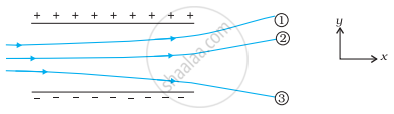
The figure shows tracks of three charged particles in a uniform electrostatic field. Give the signs of the three charges. Which particle has the highest charge to mass ratio?
An infinite line charge produces a field of 9 × 10⁴ N/C at a distance of 2 cm. Calculate the linear charge density.
In some old texts it is mentioned that 4π lines of force originate from each unit positive charge. Comment on the statement in view of the fact that 4π is not an integer.
When the separation between two charges is increased, the electric potential energy of the charges
The electric field and the electric potential at a point are E and V, respectively.
Which of the following quantities does not depend on the choice of zero potential or zero potential energy?
Consider a uniformly charged ring of radius R. Find the point on the axis where the electric field is maximum.
A particle of mass m and charge q is thrown at a speed u against a uniform electric field E. How much distance will it travel before coming to momentary rest ?
A particle of mass 1 g and charge 2.5 × 10⁻⁴ C is released from rest in an electric field of 1.2 × 10 4 N C−1. What will be the speed of the particle after travelling this distance?
An electric field \[\vec{E} = \vec{i}\] Ax exists in space, where A = 10 V m−2. Take the potential at (10 m, 20 m) to be zero. Find the potential at the origin.
Find the magnitude of the electric field at the point P in the configuration shown in the figure for d >> a.
Which of the following methods can be used to charge a metal sphere positively without touching it? Select the most appropriate.
When 1014 electrons are removed from a neutral metal sphere, the charge on the sphere becomes ______.
What does the Principle of Superposition state regarding the electric field at a point due to a group of charges?
What is the value and unit of Coulomb's constant \[\frac{1}{4\pi\varepsilon_0}\]?
