Advertisements
Advertisements
Question
A particle of mass m and charge q is thrown at a speed u against a uniform electric field E. How much distance will it travel before coming to momentary rest ?
Advertisements
Solution
Given:
Charge of the particle = q
Velocity of projection = u
Electric field intensity = E
Mass of the particle = m
We know that the force experience by a charged particle in an electric field is qE.
Acceleration produced, a = \[\frac{qE}{m}\] (Negative because the particle is thrown against the electric field)
Let the distance covered by the particle be s.
Then v2 = u2 + 2as
[Here, a = deceleration, v = final velocity]
Here, 0 = u2 − 2as
\[\Rightarrow s = \frac{u^2}{2a}\]
\[ \Rightarrow s = \frac{m u^2}{2qE}\]
APPEARS IN
RELATED QUESTIONS
An infinite line charge produces a field of 9 × 10⁴ N/C at a distance of 2 cm. Calculate the linear charge density.
Consider a system of n charges q1, q2, ... qn with position vectors `vecr_1,vecr_2,vecr_3,...... vecr_n`relative to some origin 'O'. Deduce the expression for the net electric field`vec E` at a point P with position vector `vecr_p,`due to this system of charges.
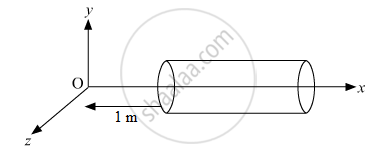
A hollow cylindrical box of length 1 m and area of cross-section 25 cm2 is placed in a three dimensional coordinate system as shown in the figure. The electric field in the region is given by `vecE = 50xhati` where E is NC−1 and x is in metres. Find
(i) Net flux through the cylinder.
(ii) Charge enclosed by the cylinder.
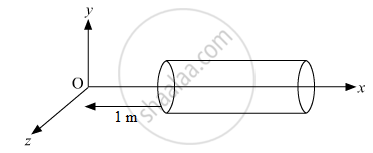
A hollow cylindrical box of length 0.5 m and area of cross-section 25 cm2 is placed in a three dimensional coordinate system as shown in the figure. The electric field in the region is given by `vecE = 20 xhati` where E is NC−1 and x is in metres. Find
(i) Net flux through the cylinder.
(ii) Charge enclosed by the cylinder.
Why does a phonograph record attract dust particles just after it is cleaned?
A point charge q is rotated along a circle in an electric field generated by another point charge Q. The work done by the electric field on the rotating charge in one complete revolution is
The electric field and the electric potential at a point are E and V, respectively.
Electric potential decreases uniformly from 120 V to 80 V, as one moves on the x-axis from x = −1 cm to x = +1 cm. The electric field at the origin
(a) must be equal to 20 Vcm−1
(b) may be equal to 20 Vcm−1
(c) may be greater than 20 Vcm−1
(d) may be less than 20 Vcm−1
The electric field in a region is directed outward and is proportional to the distance rfrom the origin. Taking the electric potential at the origin to be zero,
A wire is bent in the form of a regular hexagon and a total charge q is distributed uniformly on it. What is the electric field at the centre? You may answer this part without making any numerical calculations.
A particle of mass 1 g and charge 2.5 × 10⁻⁴ C is released from rest in an electric field of 1.2 × 10 4 N C−1. Find the electric force and the force of gravity acting on this particle. Can one of these forces be neglected in comparison with the other for approximate analysis?
A ball of mass 100 g and with a charge of 4.9 × 10⁻⁵ C is released from rest in a region where a horizontal electric field of 2.0 × 10⁴ N C−1 exists. (a) Find the resultant force acting on the ball. (b) What will be the path of the ball? (c) Where will the ball be at the end of 2 s?
Consider the situation of the previous problem. A charge of −2.0 × 10⁻⁴ C is moved from point A to point B. Find the change in electrical potential energy UB − UA for the cases (a), (b) and (c).
Find the magnitude of the electric field at the point P in the configuration shown in the figure for d >> a.
What does the Principle of Superposition state regarding the electric field at a point due to a group of charges?
For a system of n point charges, what is the mathematical expression for the total electric field at point P?
What does the symbol \[\hat{\mathbf{r}}_{iP}\] represent in the electric field formula?
What does the symbol ε₀ represent in the electric field formula?
