Advertisements
Advertisements
Question
Consider a system of n charges q1, q2, ... qn with position vectors `vecr_1,vecr_2,vecr_3,...... vecr_n`relative to some origin 'O'. Deduce the expression for the net electric field`vec E` at a point P with position vector `vecr_p,`due to this system of charges.
Advertisements
Solution
Let us consider a system of n charges q1, q2, ... qn with position vectors r1, r2, r3, ...rn relative to origin O.
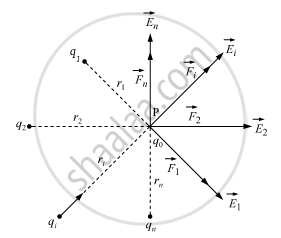
Let `vecF_i` be the force due to ith charge qi on q0.
Then,
`vecF_i = 1/(4πε_0) (q_1q_0)/(r_i^2) \ hat r_i`
Here, ri is the distance of the test charge q0 from qi.
The electric field at the observation point P is given by `vecE_i = lim_(q0->0) vecF_i/(q_0) = lim _(q0->0) 1/q_0 (1/(4πε_0) (q_1q_0)/r_1^2 hatr_i)`
`vecE_i = 1/(4πε_0) q_i/(r_1^2)hat r_i ........ (1) `
If `vecE` is the electric field at point P due to the system of charges, then by the principle of superposition of electric fields,
`vecE = vecE_1 +vecE_2 +vecE_3 +....vecE_n = sum_(i=1)^n vecE_i`
Using (1), we get
`vecE = sum_(i=1)^n 1/(4πε_0)q_i/(r_i^2)hat r_i `
`vecE =1/(4πε_0) sum_(i=1)^n q_i/(r_i^2)hat r_i`
APPEARS IN
RELATED QUESTIONS
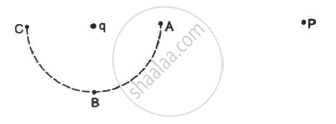
Consider the situation in the figure. The work done in taking a point charge from P to Ais WA, from P to B is WB and from P to C is WC.
Electric potential decreases uniformly from 120 V to 80 V, as one moves on the x-axis from x = −1 cm to x = +1 cm. The electric field at the origin
(a) must be equal to 20 Vcm−1
(b) may be equal to 20 Vcm−1
(c) may be greater than 20 Vcm−1
(d) may be less than 20 Vcm−1
A particle of mass m and charge q is thrown at a speed u against a uniform electric field E. How much distance will it travel before coming to momentary rest ?
A block of mass m with a charge q is placed on a smooth horizontal table and is connected to a wall through an unstressed spring of spring constant k, as shown in the figure. A horizontal electric field E, parallel to the spring, is switched on. Find the amplitude of the resulting SHM of the block. 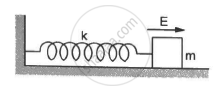
An electric field \[\vec{E} = ( \vec{i} 20 + \vec{j} 30) {NC}^{- 1}\] exists in space. If the potential at the origin is taken to be zero, find the potential at (2 m, 2 m).
Find the magnitude of the electric field at the point P in the configuration shown in the figure for d >> a.
Which of the following methods can be used to charge a metal sphere positively without touching it? Select the most appropriate.
What does the symbol \[\hat{\mathbf{r}}_{iP}\] represent in the electric field formula?
What does the symbol ε₀ represent in the electric field formula?
