Advertisements
Advertisements
Question
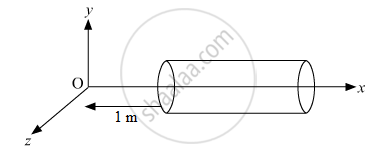
A hollow cylindrical box of length 0.5 m and area of cross-section 25 cm2 is placed in a three dimensional coordinate system as shown in the figure. The electric field in the region is given by `vecE = 20 xhati` where E is NC−1 and x is in metres. Find
(i) Net flux through the cylinder.
(ii) Charge enclosed by the cylinder.
Advertisements
Solution
(i) Given,
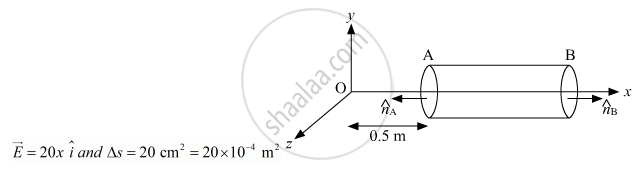
As the electric field is only along the x-axis, so, flux will pass only through the cross-section of cylinder.
Magnitude of electric field at A,
`E_A = 20 xx 0.5 = 10 N C^-1`
Magnitude of lelectic field at cross - section B
EB = 20 × 1= 20 NC-1
The corresponding eletric fluxes are
`phi_A = vecE.Δvecs = 10 xx 20 xx 10^-4 xx cos 180° = - 0.02 N m^2 C^-1`
`phi_B = vecE.Δvecs = 20 xx 20 xx 10^-4 xx cos0° = 0.04 N m^2 C^-1`
So, the net flux through the cylinder,
`phi = phi _A + phi_B = - 0.02 + 0.04 = 0.02 N m^2 C^-1 xx 10^12C`
(ii) Using Gauss’s law:
`oint vecE. vecds = q/in_0 => 0.02 = q/(8.85 xx 10^-12) => q =8.85 xx 0.02 xx 10^-12 = 0.177 xx 10^12 C`
APPEARS IN
RELATED QUESTIONS
Show that if we connect the smaller and the outer sphere by a wire, the charge q on the former will always flow to the latter, independent of how large the charge Q is.
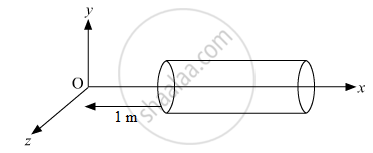
A hollow cylindrical box of length 1 m and area of cross-section 25 cm2 is placed in a three dimensional coordinate system as shown in the figure. The electric field in the region is given by `vecE = 50xhati` where E is NC−1 and x is in metres. Find
(i) Net flux through the cylinder.
(ii) Charge enclosed by the cylinder.
The charge on a proton is +1.6 × 10⁻¹⁹ C and that on an electron is −1.6 × 10⁻¹⁹ C. Does it mean that the electron has 3.2 × 10⁻¹⁹ C less charge than the proton?
Why does a phonograph record attract dust particles just after it is cleaned?
A 10-cm long rod carries a charge of +50 μC distributed uniformly along its length. Find the magnitude of the electric field at a point 10 cm from both ends of the rod.
Find the magnitude of the electric field at the point P in the configuration shown in the figure for d >> a.
For a system of n point charges, what is the mathematical expression for the total electric field at point P?
