Advertisements
Advertisements
Question
The electric potential existing in space is \[\hspace{0.167em} V(x, y, z) = A(xy + yz + zx) .\] (a) Write the dimensional formula of A. (b) Find the expression for the electric field. (c) If A is 10 SI units, find the magnitude of the electric field at (1 m, 1 m, 1 m).
Advertisements
Solution
Given:
Electric potential,
\[V(x, y, z) = A(xy + yz + zx)\]
\[A = \frac{\text{ volt }}{m^2}\]
\[ \Rightarrow \left[ A \right] = \frac{\left[ {ML}^2 I^{- 1} T^{- 3} \right]}{\left[ L^2 \right]}\]
\[ \Rightarrow A = [ {MT}^{- 3} I^{- 1} ]\]
(b) Let E be the electric field.
\[dV = - \vec{E} . \vec{dr} \]
\[ \Rightarrow A(y + z)dx + A(z + x)dy + A(x + y)dz = - E(dx \hat{i} + dy \hat{j} + dz\hat{ k } )\]
\[ \Rightarrow [A(y + z) \hat{i } + A(z + x)\hat{ j } + A(x + y) \hat{ k } ] [dx\hat{ i} + dy \hat{j } + dz \hat{k } ] = - E\left[ dx \hat{ i }+ dy\hat{ j } + dz \hat{ k } \right]\]
Equating now, we get
\[\vec{E} = - A(y + z) \hat{ i } - A(z + x) \hat{ j } - A(x + y) \hat{ k }\]
(c) Given: A = 10 V/m2
\[r = (1 m, 1 m, 1 m)\]
\[ \vec{E} = - 10 (2) \hat{ i } - 10 (2) \hat{ j } - 10 (2) \hat{ k } \]
\[ = - 20 \hat{ i } - 20 \hat{ j } - 20 \hat{ k }\]
Magnitude of electric field,
\[\left| E \right| = \sqrt{{20}^2 + {20}^2 + {20}^2}\]
\[ = \sqrt{1200} = 34 . 64 = 35\] N/C
APPEARS IN
RELATED QUESTIONS
An infinite line charge produces a field of 9 × 10⁴ N/C at a distance of 2 cm. Calculate the linear charge density.
The charge on a proton is +1.6 × 10⁻¹⁹ C and that on an electron is −1.6 × 10⁻¹⁹ C. Does it mean that the electron has 3.2 × 10⁻¹⁹ C less charge than the proton?
In some old texts it is mentioned that 4π lines of force originate from each unit positive charge. Comment on the statement in view of the fact that 4π is not an integer.
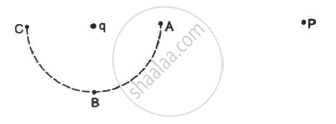
Consider the situation in the figure. The work done in taking a point charge from P to Ais WA, from P to B is WB and from P to C is WC.
Electric potential decreases uniformly from 120 V to 80 V, as one moves on the x-axis from x = −1 cm to x = +1 cm. The electric field at the origin
(a) must be equal to 20 Vcm−1
(b) may be equal to 20 Vcm−1
(c) may be greater than 20 Vcm−1
(d) may be less than 20 Vcm−1
Consider a uniformly charged ring of radius R. Find the point on the axis where the electric field is maximum.
A particle of mass m and charge q is thrown at a speed u against a uniform electric field E. How much distance will it travel before coming to momentary rest ?
A particle of mass 1 g and charge 2.5 × 10⁻⁴ C is released from rest in an electric field of 1.2 × 10 4 N C−1. What will be the speed of the particle after travelling this distance?
A particle of mass 1 g and charge 2.5 × 10⁻⁴ C is released from rest in an electric field of 1.2 × 10 4 N C−1. How much is the work done by the electric force on the particle during this period?
A ball of mass 100 g and with a charge of 4.9 × 10⁻⁵ C is released from rest in a region where a horizontal electric field of 2.0 × 10⁴ N C−1 exists. (a) Find the resultant force acting on the ball. (b) What will be the path of the ball? (c) Where will the ball be at the end of 2 s?
A block of mass m with a charge q is placed on a smooth horizontal table and is connected to a wall through an unstressed spring of spring constant k, as shown in the figure. A horizontal electric field E, parallel to the spring, is switched on. Find the amplitude of the resulting SHM of the block. 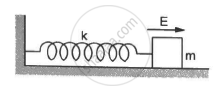
In general, metallic ropes are suspended on the carriers taking inflammable materials. The reason is ______.
When 1014 electrons are removed from a neutral metal sphere, the charge on the sphere becomes ______.
The Electric field at a point is ______.
- always continuous.
- continuous if there is no charge at that point.
- discontinuous only if there is a negative charge at that point.
- discontinuous if there is a charge at that point.
What does the Principle of Superposition state regarding the electric field at a point due to a group of charges?
What is the value and unit of Coulomb's constant \[\frac{1}{4\pi\varepsilon_0}\]?
Which key point best describes how each individual electric field is calculated in a system of multiple charges?
