Advertisements
Advertisements
प्रश्न
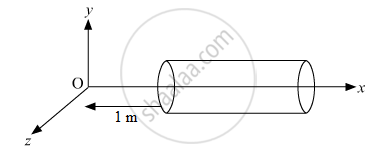
A hollow cylindrical box of length 0.5 m and area of cross-section 25 cm2 is placed in a three dimensional coordinate system as shown in the figure. The electric field in the region is given by `vecE = 20 xhati` where E is NC−1 and x is in metres. Find
(i) Net flux through the cylinder.
(ii) Charge enclosed by the cylinder.
Advertisements
उत्तर
(i) Given,
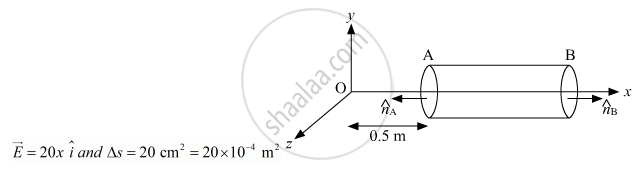
As the electric field is only along the x-axis, so, flux will pass only through the cross-section of cylinder.
Magnitude of electric field at A,
`E_A = 20 xx 0.5 = 10 N C^-1`
Magnitude of lelectic field at cross - section B
EB = 20 × 1= 20 NC-1
The corresponding eletric fluxes are
`phi_A = vecE.Δvecs = 10 xx 20 xx 10^-4 xx cos 180° = - 0.02 N m^2 C^-1`
`phi_B = vecE.Δvecs = 20 xx 20 xx 10^-4 xx cos0° = 0.04 N m^2 C^-1`
So, the net flux through the cylinder,
`phi = phi _A + phi_B = - 0.02 + 0.04 = 0.02 N m^2 C^-1 xx 10^12C`
(ii) Using Gauss’s law:
`oint vecE. vecds = q/in_0 => 0.02 = q/(8.85 xx 10^-12) => q =8.85 xx 0.02 xx 10^-12 = 0.177 xx 10^12 C`
APPEARS IN
संबंधित प्रश्न
An infinite line charge produces a field of 9 × 10⁴ N/C at a distance of 2 cm. Calculate the linear charge density.
Show that if we connect the smaller and the outer sphere by a wire, the charge q on the former will always flow to the latter, independent of how large the charge Q is.
When the separation between two charges is increased, the electric potential energy of the charges
A point charge q is rotated along a circle in an electric field generated by another point charge Q. The work done by the electric field on the rotating charge in one complete revolution is
A particle of mass 1 g and charge 2.5 × 10⁻⁴ C is released from rest in an electric field of 1.2 × 10 4 N C−1. How much is the work done by the electric force on the particle during this period?
An electric field of 20 NC−1 exists along the x-axis in space. Calculate the potential difference VB − VA where the points A and B are
(a) A = (0, 0); B = (4 m, 2m)
(b) A = (4 m, 2 m); B = (6 m, 5 m)
(c) A = (0, 0); B = (6 m, 5 m)
Do you find any relation between the answers of parts (a), (b) and (c)?
The electric potential existing in space is \[\hspace{0.167em} V(x, y, z) = A(xy + yz + zx) .\] (a) Write the dimensional formula of A. (b) Find the expression for the electric field. (c) If A is 10 SI units, find the magnitude of the electric field at (1 m, 1 m, 1 m).
Which of the following methods can be used to charge a metal sphere positively without touching it? Select the most appropriate.
Five charges, q each are placed at the corners of a regular pentagon of side ‘a’ (Figure).
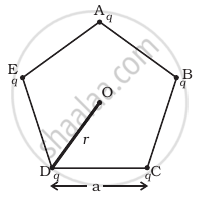
(a) (i) What will be the electric field at O, the centre of the pentagon?
(ii) What will be the electric field at O if the charge from one of the corners (say A) is removed?
(iii) What will be the electric field at O if the charge q at A is replaced by –q?
(b) How would your answer to (a) be affected if pentagon is replaced by n-sided regular polygon with charge q at each of its corners?
What is the value and unit of Coulomb's constant \[\frac{1}{4\pi\varepsilon_0}\]?
