Advertisements
Advertisements
प्रश्न
The electric field in a region is directed outward and is proportional to the distance rfrom the origin. Taking the electric potential at the origin to be zero,
पर्याय
it is uniform in the region
it is proportional to r
it is proportional to r2
it increases as one moves away from the origin
Advertisements
उत्तर
it is proportional to r2
Given:
E \[\propto\] r and V = 0 at r =0
⇒ E = kr
Also, E = \[\frac{- dV}{dr}\]
\[\therefore V = - \int Edr\]
\[ \Rightarrow V = - \int krdr\]
\[ \Rightarrow V = - k\frac{r^2}{2} + C\]
Using the condition, V = 0 at r = 0, we get C =0.
Therefore,
\[V = - k\frac{r^2}{2}\]
\[ \Rightarrow V \propto r^2\]
APPEARS IN
संबंधित प्रश्न
The charge on a proton is +1.6 × 10⁻¹⁹ C and that on an electron is −1.6 × 10⁻¹⁹ C. Does it mean that the electron has 3.2 × 10⁻¹⁹ C less charge than the proton?
Why does a phonograph record attract dust particles just after it is cleaned?
Consider the situation in the figure. The work done in taking a point charge from P to Ais WA, from P to B is WB and from P to C is WC.
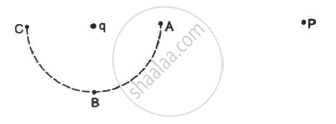
The electric field and the electric potential at a point are E and V, respectively.
A particle of mass 1 g and charge 2.5 × 10⁻⁴ C is released from rest in an electric field of 1.2 × 10 4 N C−1. Find the electric force and the force of gravity acting on this particle. Can one of these forces be neglected in comparison with the other for approximate analysis?
A particle of mass 1 g and charge 2.5 × 10⁻⁴ C is released from rest in an electric field of 1.2 × 10 4 N C−1. What will be the speed of the particle after travelling this distance?
An electric field \[\vec{E} = ( \vec{i} 20 + \vec{j} 30) {NC}^{- 1}\] exists in space. If the potential at the origin is taken to be zero, find the potential at (2 m, 2 m).
An electric field \[\vec{E} = \vec{i}\] Ax exists in space, where A = 10 V m−2. Take the potential at (10 m, 20 m) to be zero. Find the potential at the origin.
The kinetic energy of a charged particle decreases by 10 J as it moves from a point at potential 100 V to a point at potential 200 V. Find the charge on the particle.
Find the magnitude of the electric field at the point P in the configuration shown in the figure for d >> a.
Assume that each atom in a copper wire contributes one free electron. Estimate the number of free electrons in a copper wire of mass 6.4 g (take the atomic weight of copper to be 64 g mol−1).
Which of the following methods can be used to charge a metal sphere positively without touching it? Select the most appropriate.
The electric field intensity produced by the radiations coming from 100 W bulb at 3 m distance is E. The electric field intensity produced by the radiations coming from 50 W bulb at the same distance is:
Five charges, q each are placed at the corners of a regular pentagon of side ‘a’ (Figure).
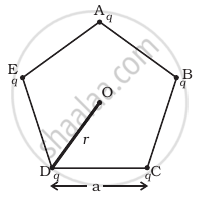
(a) (i) What will be the electric field at O, the centre of the pentagon?
(ii) What will be the electric field at O if the charge from one of the corners (say A) is removed?
(iii) What will be the electric field at O if the charge q at A is replaced by –q?
(b) How would your answer to (a) be affected if pentagon is replaced by n-sided regular polygon with charge q at each of its corners?
What does the Principle of Superposition state regarding the electric field at a point due to a group of charges?
For a system of n point charges, what is the mathematical expression for the total electric field at point P?
What does the symbol \[\hat{\mathbf{r}}_{iP}\] represent in the electric field formula?
