Advertisements
Advertisements
प्रश्न
The Electric field at a point is ______.
- always continuous.
- continuous if there is no charge at that point.
- discontinuous only if there is a negative charge at that point.
- discontinuous if there is a charge at that point.
पर्याय
a and b
b and d
c and d
a and d
Advertisements
उत्तर
b and d
Explanation:
We cannot define electric field at the position of a charge, so we cannot say that an electric field is always continuous. Hence option (a) is ruled out and option (d) is the correct choice. The electric field due to any charge will be continuous if there is no other charge in the medium. It will be discontinuous if there is a charge at the point under consideration, hence option (b) is correct.
APPEARS IN
संबंधित प्रश्न
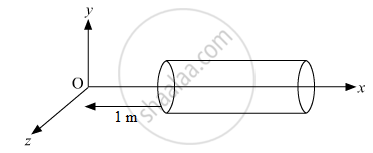
A hollow cylindrical box of length 1 m and area of cross-section 25 cm2 is placed in a three dimensional coordinate system as shown in the figure. The electric field in the region is given by `vecE = 50xhati` where E is NC−1 and x is in metres. Find
(i) Net flux through the cylinder.
(ii) Charge enclosed by the cylinder.
The charge on a proton is +1.6 × 10⁻¹⁹ C and that on an electron is −1.6 × 10⁻¹⁹ C. Does it mean that the electron has 3.2 × 10⁻¹⁹ C less charge than the proton?
If a body is charged by rubbing it, its weight
Consider the situation in the figure. The work done in taking a point charge from P to Ais WA, from P to B is WB and from P to C is WC.
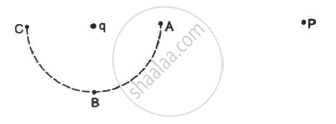
A point charge q is rotated along a circle in an electric field generated by another point charge Q. The work done by the electric field on the rotating charge in one complete revolution is
Which of the following quantities does not depend on the choice of zero potential or zero potential energy?
The electric field in a region is directed outward and is proportional to the distance rfrom the origin. Taking the electric potential at the origin to be zero,
Consider a uniformly charged ring of radius R. Find the point on the axis where the electric field is maximum.
A wire is bent in the form of a regular hexagon and a total charge q is distributed uniformly on it. What is the electric field at the centre? You may answer this part without making any numerical calculations.
A particle of mass m and charge q is thrown at a speed u against a uniform electric field E. How much distance will it travel before coming to momentary rest ?
A particle of mass 1 g and charge 2.5 × 10⁻⁴ C is released from rest in an electric field of 1.2 × 10 4 N C−1. How much is the work done by the electric force on the particle during this period?
An electric field of 20 NC−1 exists along the x-axis in space. Calculate the potential difference VB − VA where the points A and B are
(a) A = (0, 0); B = (4 m, 2m)
(b) A = (4 m, 2 m); B = (6 m, 5 m)
(c) A = (0, 0); B = (6 m, 5 m)
Do you find any relation between the answers of parts (a), (b) and (c)?
Consider the situation of the previous problem. A charge of −2.0 × 10⁻⁴ C is moved from point A to point B. Find the change in electrical potential energy UB − UA for the cases (a), (b) and (c).
The kinetic energy of a charged particle decreases by 10 J as it moves from a point at potential 100 V to a point at potential 200 V. Find the charge on the particle.
Find the magnitude of the electric field at the point P in the configuration shown in the figure for d >> a.
In general, metallic ropes are suspended on the carriers taking inflammable materials. The reason is ______.
What does the Principle of Superposition state regarding the electric field at a point due to a group of charges?
According to the procedure for calculating electric field due to a system of charges, what is the first step?
