Advertisements
Advertisements
प्रश्न
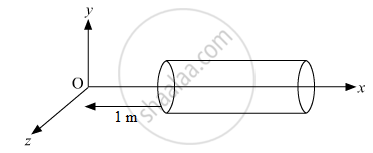
A hollow cylindrical box of length 1 m and area of cross-section 25 cm2 is placed in a three dimensional coordinate system as shown in the figure. The electric field in the region is given by `vecE = 50xhati` where E is NC−1 and x is in metres. Find
(i) Net flux through the cylinder.
(ii) Charge enclosed by the cylinder.
Advertisements
उत्तर
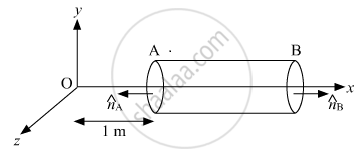
Given,`vecE = 50xhati and Δs = 25 cm^2 = 25 xx 10^-4 m^2`
As the electric field is only along the x-axis, so, flux will pass only through the cross-section of cylinder.
magnitude of electric field at cross - section A,`E_A = 50 xx 1 =50N C^-1`
magnitude of electric field at cross - section `B,E^B = 50 xx 2 = 100 N C^-1`
The corresponding electric fluxes are :
`ø_A = vecE.Δvecs = 50 xx 25 xx 10^-4 xx cos 180° = -0.125 N m^2 C^-1`
`ø_A = vecE.Δvecs = 100 xx 25 xx 10^-4 xx cos 0° = 0.25N m^2 C^-1`
So, the net flux through the cylinder,`ø =ø_A +ø_B = -0.125 + 0.25 = 0 . 125 N m^2C^-1 `
(ii) Using Gauss’s law: `ointvecE.dvecs =q/in_0⇒ 0.125 = q/(8.85 xx 10^-12)⇒ q=8.85 xx 0.125 xx 10^-12 =1.1 xx 10 ^-12 C `
संबंधित प्रश्न
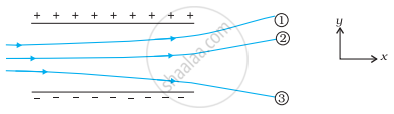
The figure shows tracks of three charged particles in a uniform electrostatic field. Give the signs of the three charges. Which particle has the highest charge to mass ratio?
An infinite line charge produces a field of 9 × 10⁴ N/C at a distance of 2 cm. Calculate the linear charge density.
Show that if we connect the smaller and the outer sphere by a wire, the charge q on the former will always flow to the latter, independent of how large the charge Q is.
Consider a system of n charges q1, q2, ... qn with position vectors `vecr_1,vecr_2,vecr_3,...... vecr_n`relative to some origin 'O'. Deduce the expression for the net electric field`vec E` at a point P with position vector `vecr_p,`due to this system of charges.
The electric field and the electric potential at a point are E and V, respectively.
A particle of mass 1 g and charge 2.5 × 10⁻⁴ C is released from rest in an electric field of 1.2 × 10 4 N C−1. Find the electric force and the force of gravity acting on this particle. Can one of these forces be neglected in comparison with the other for approximate analysis?
Consider the situation of the previous problem. A charge of −2.0 × 10⁻⁴ C is moved from point A to point B. Find the change in electrical potential energy UB − UA for the cases (a), (b) and (c).
When 1014 electrons are removed from a neutral metal sphere, the charge on the sphere becomes ______.
Five charges, q each are placed at the corners of a regular pentagon of side ‘a’ (Figure).
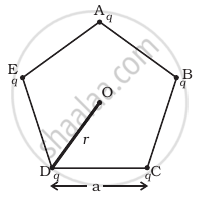
(a) (i) What will be the electric field at O, the centre of the pentagon?
(ii) What will be the electric field at O if the charge from one of the corners (say A) is removed?
(iii) What will be the electric field at O if the charge q at A is replaced by –q?
(b) How would your answer to (a) be affected if pentagon is replaced by n-sided regular polygon with charge q at each of its corners?
